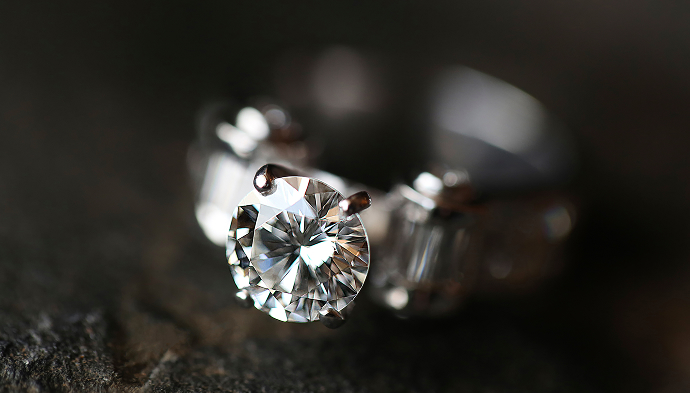
What Is A Chameleon Diamond | Diamond That Changes Color In Light


Chameleon is an amphibian. It is most well-known for its ability to change colors. The animal world is full of such magnificent secrets. But so is the world of diamonds—colorful and vivid.
And we’re not talking about just fancy coloured diamonds. What if we told you diamonds change colors too, as good as chameleons? It’s true.
Let’s uncover all the colors of chameleon diamonds in this blog.
What is a chameleon diamond?
Symbolic to its name, chameleon diamonds are color changing gemstones. They change colors when exposed to different kinds of light, darkness and temperature. The gemstone changes color from a solid yellow-green to a hue of yellow when exposed to heat. Then, when removed from heat and brought into natural light, it comes back to its original yellow-green color within minutes. It’s no wonder why it’s called a chameleon diamond.
Types of chameleon diamonds
There are two types of chameleon color changing gemstones—classic and reverse.
Classic chameleon diamonds display thermochromic and photochromic patterns. Thermochromic capability enables the diamond to temporarily change to a darker color when heated from 150 degree celsius to 250 degree celsius. Conversely, the photochromic capability enables it to change to a darker color when stored in a dark place for a long time.
Reverse chameleon diamonds are synonymous with their name. They are the opposite of classic chameleons. They do not have a reaction to temperature changes such as classic diamonds. The photochromic capability of reverse chameleon diamonds enables it to change to a lighter gemstone color when stored in a dark place for a long time.
Why do chameleon diamonds change color?
Why chameleon diamonds change color is a mystery. Since these diamond colors change when they’re exposed to light, there could be many technical reasons at work. Moreover, there isn’t too much research done around chameleon diamonds because they are rare and hence, not easily available as samples that can be used for research and study.
Chameleon diamonds: history
The earliest known chameleon diamond is said to be from 1866 by Georges Haphen, a diamond merchant in Paris. The term chameleon diamond was first used in 1943. There’s a story from the 1970’s about a person who bought a yellow-green diamond. When he removed the diamond from the jewelry box, the gemstone color had turned dark green.
How are chameleon diamonds graded?
The GIA follows the standard grading procedure for colored diamonds—record the diamond’s visible absorption spectrum. How is the spectrum recorded? The diamond is illuminated with light. In this process, some of the light gets absorbed and some of it gets transmitted. The transmitted portion is the color of the diamond.
Chameleon diamonds have a unique absorption spectrum and color. Lab experts look for color change behavior when diamonds are exposed to heat or darkness. For chameleon diamonds, the lab experts mention color changes.
Famous chameleon diamonds
One of the world’s largest chameleon diamonds weighing 31.31 carats, is said to have been purchased by a Swiss luxury watch, jewelry and accessories company in 2007.
Another famous chameleon diamond was the 8.04-carat fancy dark gray-green stone, which was surrounded by pink diamonds.
In 2001, a fancy dark gray-yellowish-green chameleon diamond ring was sold at Christie’s Hong Kong auction. It was 4.41 carat triangular stone set in a platinum mount.
Key characteristics of chameleon diamonds
- Chameleon diamonds do not appear in all colors. For example, they aren’t available in intense colors.
- Chameleon diamonds always include color combinations and diamond fluorescence.
- The combinations include colors such as yellow, green, brown and gray.
- There are two types of chameleon diamonds—classic and reverse.
- Among the most common color combinations are brown-yellow, gray-yellow, gray-green, brown-green, and green-yellow.
- No two chameleon diamond colors are alike.
Final thoughts
Chameleon diamonds are mysterious and unique. And there lies its beauty. While many might avoid buying chameleon diamonds because of the gemstone colors change, this is the exact quality that many want to have chameleon diamonds in their collection.
Whether you must buy a chameleon diamond or not is a personal choice. However, given the novelty and uniqueness, who wouldn’t want to have a piece of jewelry studded with color changing diamonds!