What Does Diamond Clarity Mean?


When buying a diamond, you’ll come across the term ‘clarity’ quite a lot. While the term is self explanatory, there’s a lot more to diamond clarity that you might imagine. It is graded on a specific diamond clarity chart, each grade refers to a specific type of clarity, it determines its value and price, and much more.
If you want to learn all about diamond clarity, this guide is for you.
Diamond clarity definition
Diamond clarity means how pure and clean a diamond is on the inside and outside. A diamond with a high clarity grade does not have inclusions, such as blemishes, cracks, clouds, etc. The higher a diamond’s clarity grade, the more valuable it tends to be.
Why is clarity important in diamond grading?
Diamond clarity is important in diamond grading as it is one of the main 4Cs – cut, color, carat, and clarity. Clarity is important because a clear diamond allows light to travel through it more easily, creating brilliance and sparkle. Moreover, a diamond with high clarity on the diamond clarity chart makes the diamond more valuable.
How is diamond clarity determined?
Diamonds are assessed for various parameters by gemologists. Most of the assessment requires special equipment and magnification to segregate them based on grade on the diamond clarity chart. Here’s how diamond clarity is determined.
Factors used to evaluate diamond clarity
Here are five factors used to assess diamond clarity.
|
Size |
Larger inclusions impact diamond clarity more than smaller ones. |
|
Number |
The more flaws in a diamond mean lower clarity grade. |
|
Position |
A flaw directly under the table of a diamond is more noticeable. |
|
Nature |
Flaws such as a crack are more visible and impact diamond clarity grade. |
|
Relief |
This refers to how much a flaw stands out against the surrounding diamond. |
Role of magnification in clarity assessment
Most diamond inclusions cannot be seen with the naked eye, and hence, gemologists use 10x magnification. 10x magnification is the global standard in diamond clarity assessment that is used to define clarity based on diamond clarity chart. If inclusions are not visible at 10x, it does not affect the clarity grade.
Understanding diamond inclusions and blemishes
There are different kinds of diamond inclusions and blemishes. Some are inside the diamond, and some outside. The ones that are inside form during the process of growth, in laboratory in case of lab grown diamonds and under the Earth’s surface, in case of natural diamonds.
Here are some common types of inclusions:
-
Crystals: Tiny mineral crystals
-
Needles: Long, thin crystals that look like needles
-
Clouds: A cluster of very tiny inclusions
-
Feathers: Small fractures or cracks inside the diamond
-
Knots: Crystal inclusions
-
Chips: Small breaks on the surface or edges
Here are some common types of blemishes:
-
Scratches: Fine lines on the surface
-
Nicks: Tiny notches on the edges of the diamond
-
Pits: Tiny holes or indentations on the surface
-
Polish lines: Very fine lines from the polishing process
-
Abrasions: Rough areas along the edges
Diamond clarity chart explained
The Gemological Institute of America has created one of the most widely used diamond clarity grading scales. It has six categories and eleven grades on the diamond clarity chart.

Flawless (FL)
FL diamonds do not have inclusions or blemishes when viewed under 10x magnification. It is the highest clarity grade. Only a fraction of mined diamonds fall in the FL grade. Lab grown diamond FL diamonds are common and easy to customize.
Internally Flawless (IF)
IF on diamond clarity chart refers to diamonds that do not have inclusions visible under 10X magnification. However, they can have minor blemishes on the surface. IF diamonds, too, are rare and premium. The difference between FL and IF diamonds is surface-level and cannot be known through the naked eye.
Also Read: What Are Flawless Diamonds And Internally Flawless Diamonds
Very Very Slightly Included
VVS diamonds have tiny inclusions that are extremely hard to see even under 10x magnification. These inclusions do not have any impact on the diamond’s beauty. VVS diamonds are considered excellent quality as they look flawless to the naked eye and are perfect for those looking for excellent diamond clarity.
Related Article : What Are VVS Diamonds? – Meaning and Buying Guide
Very Very Slightly Included (VVS1 and VVS2)
VVS1 diamonds have inclusions that are harder to detect, mostly located toward the bottom of the diamond. And VVS2 diamonds have inclusions that are slightly easier to spot, mostly closer to the table.
Related Article : Difference Between VVS2 vs VVS1 Lab Grown Diamond Grades
Very Slightly Included
VS diamonds have inclusions that are minor and difficult to see under 10x magnification. VS1 diamond inclusions are harder to spot under magnification, while VS2 inclusions are slightly easier to spot, but require magnification. VS clarity diamonds cost significantly less than VVS or Flawless diamond clarity.
Slightly Included (SI1 and SI2)
SI on diamond clarity chart refers to inclusions that are noticeable under 10x magnification. Some SI2 diamond inclusions may be visible to the naked eye as well. SI1 inclusions are usually not visible without magnification.
Related Article : Comparing SI1 vs SI2 Diamond Clarity
Included (I1, I2, and I3)
Included diamonds have flaws that are clearly visible under 10x magnification. They can be easily visible to the naked eye as well. These inclusions affect the diamond’s brilliance. Included diamond clarity grades are the most affordable.
Diamond clarity chart
|
Clarity grade |
Visible to naked eye |
Visible under 10x magnification |
Eye clean |
|
FL |
No |
No |
Yes |
|
IF |
No |
No, minor surface only |
Yes |
|
VVS1 |
No |
Very difficult |
Yes |
|
VVS2 |
No |
Difficult |
Yes |
|
VS1 |
No |
Minor, somewhat difficult |
Yes |
|
VS2 |
No |
Minor, noticeable |
Yes |
|
SI1 |
Rarely |
Yes, easily |
Usually |
|
SI2 |
Sometimes |
Yes, easily |
Sometimes |
|
I1 |
Often |
Very easily |
Rarely |
|
I2 |
Usually |
Prominently |
No |
|
I3 |
Yes, clearly |
Very prominently |
No |
Common misconceptions about diamond clarity
Higher diamond clarity always means better appearance
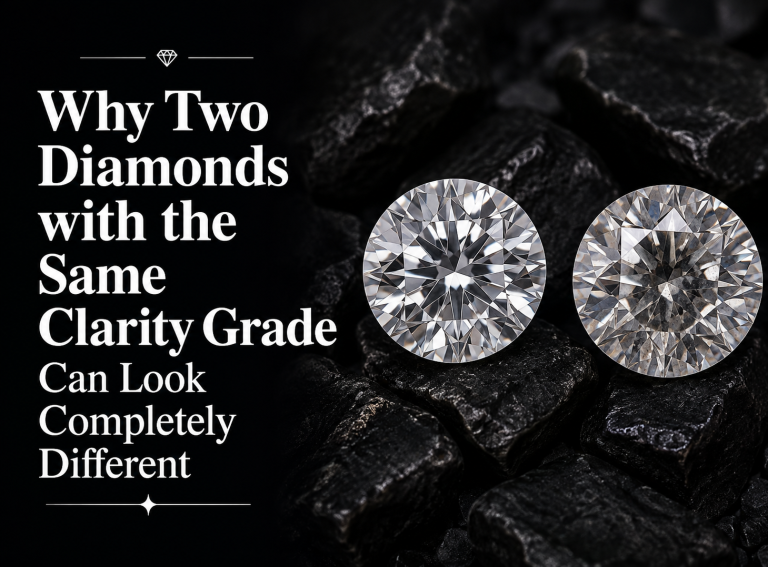
It’s a common assumption that a FL or VVS diamond will look visually more appealing than a VS2 or SI1. What actually determines a diamond’s beauty is its cut quality, as it controls how light enters, bounces around inside, and exits the stone.
Inclusions are always visible
The assumption that inclusions are always visible causes anxiety to diamond buyers. And hence they overpay for higher diamond clarity grades, which they do not need. The truth is that a large type of diamond inclusions are not visible to the naked eye.
Flawless diamond clarity is necessary
Most customers think FL is the only clarity grade they should look for when buying engagement rings. But that’s unnecessary. That’s because there are other grades on the diamond clarity chart that are almost like FL diamonds and available at a lower price. For example, VS1 diamonds.
Diamond buying tips around clarity
-
Check the location of the inclusion; not just the grade
-
Think about your preferred shape and cut of the diamond before choosing a clarity grade
-
Focus on the overall value of the diamond rather than just clarity
-
Consider other factors such as fluorescence, brilliance, sparkle, etc, beyond the 4Cs
Wrapping up: How to choose the best diamond clarity
Diamond clarity is one of the most important factors when buying diamonds. However, it is not important to always buy a Flawless diamond. Other grades on the diamond clarity chart with fewer inclusions that are not visible to the naked eye also provide similar aesthetic value and performance. Think VS1 and VS2.
When buying diamonds, use the diamond clarity chart as a guide, not as something that has to be followed strictly. If you’re looking for high quality diamonds, explore Grown Diamond Corporation.