Round Brilliant Cut Diamond: Why It’s the Most Popular Choice


In 2025, round brilliant cut diamonds are making up 62% of all engagement ring sales in the whole world. Every new shape comes, gets famous for some time, and then goes away. But this round brilliant is always staying there only. This type of permanent power is coming from the cut itself.
What Is a Round Brilliant Cut Diamond?
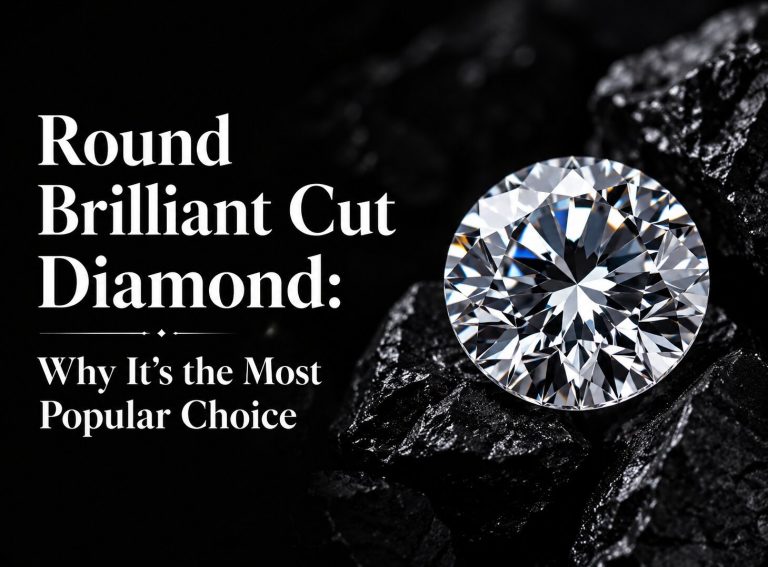
A round brilliant cut diamond has 57 or 58 precisely placed facets, and every single one has one job, which is to return light back to your eye. The table gathers light from above. The crown facets break it into brilliance and fire. The pavilion bounces it back upward. When the proportions are right, the whole system works like an optical machine.
| Feature | Detail |
| Facets | 57 or 58 |
| Market share | 62% of engagement ring sales in 2025 |
| Cut standard | Excellent (IGI) or GCAL 8X verified |
| Cut origin | Marcel Tolkowsky, 1919 |
| Best for | Engagement rings, stud earrings, pendants |
Why the Round Brilliant Cut Is the World’s Favorite Diamond Shape
Designed for Maximum Sparkle
In 1919, one Belgian mathematician named Marcel Tolkowsky made a book called Diamond Design. He came from a diamond-cutting family only. He used proper math calculations to see how light travels inside the diamond. His final result was a 58-facet round brilliant with exact angles and size. Today also, the full diamond market follows his same design only.
If the bottom is very deep, light falls down from the bottom. If the top is very flat, fire dies. His proper sizing holds the light and bounces it directly to our eyes. This makes the diamond look fully alive.
Timeless Style That Never Goes Out of Fashion
Oval cuts peaked and came back down. Princess cuts had their decade. The round cut lab grown diamond, across every market cycle, holds its position. It works in every setting and every metal colour because its symmetry is equal in all directions. You can rotate it in any setting and it reads identically.
Perfect for Every Jewellery Style and Occasion
Round diamond stud earrings are the most consistently sold diamond jewellery item outside of engagement rings. The shape works for daily wear because it has no corners to chip, no orientation issues in a bezel, and no awkward angles when set in a prong. For retailers this means lower return rates and fewer complaints overall.
What Makes a Round Brilliant Sparkle More Than Other Shapes
The Science Behind 57 to 58 Facets
The crown has 33 facets including one table, eight bezels, eight stars, and sixteen upper girdle facets. The pavilion has 24 facets plus an optional culet at the tip. Each one sits at a calculated angle. When you see a round brilliant sparkle, you are seeing this system working exactly as Tolkowsky calculated it a century ago.
Light Performance: Brilliance, Fire and Scintillation
- Brilliance is the white light coming straight back to your eye.
- Fire is the coloured flashes as the diamond moves.
- Scintillation is the shifting pattern of bright and dark that makes a diamond look alive.
A properly cut round brilliant produces all three. Most fancy shapes manage only one or two at the same time.
Why Precision Cutting Matters More Than Carat Size
A 1-carat round brilliant with an excellent cut will always shine brighter than a 1.5-carat diamond with just a good cut in any lighting. We are telling this same thing to every buyer only. Carat weight is just telling how heavy the diamond is. But cut quality is telling how much of that weight will change into beautiful light for your eyes. So you must see the cut first always; never go for just a big size.
The 4Cs for Round Brilliant Cut Diamonds
- Cut: Round brilliant is the only diamond shape that is getting a proper full cut grade on its certificate. Other fancy shapes like oval or cushions are not getting this standard grade. This is because every maker is cutting them in different sizes only. Because of this reason, checking and comparing round brilliant diamonds is becoming very much easier for the buyers.
- Color: G and H color grades are the most commercially practical. They look colorless in most settings and price meaningfully lower than D through F. In yellow gold settings, the H color disappears completely. We recommend G for most retail applications.
- Clarity: VS2 is the sweet spot for most people. It is eye-clean across virtually all round brilliant sizes and prices below VS1 and VVS. SI1 can also work because brilliant faceting scatters inclusions visually.
- Carat Weight: A good 1-carat round brilliant looks 6.4 to 6.5 mm from the top. A badly cut 1.2-carat diamond also shows the same size only, because extra weight just rests deep inside the bottom part. Always ask for millimeter measurements with carat weight to know the clear picture.
Ideal Cut vs Excellent Cut: What’s the Difference?
How Grading Affects Beauty and Price
- IGI uses Excellent as its top cut grade for round brilliant lab grown diamonds.
- GCAL 8X goes further by measuring actual optical performance rather than grading proportions on paper.
A diamond can receive an Excellent grade based on proportions while still having symmetry issues that only show under a scope.
Which Cut Grade Offers the Best Value?
Master Cut Diamonds at Grown Diamond Corporation are verified to GCAL 8X standards, covering brightness, fire, scintillation, light symmetry, optical symmetry, polish, fluorescence, and the hearts and arrows pattern all together.
Round Brilliant Cut vs Other Popular Diamond Shapes
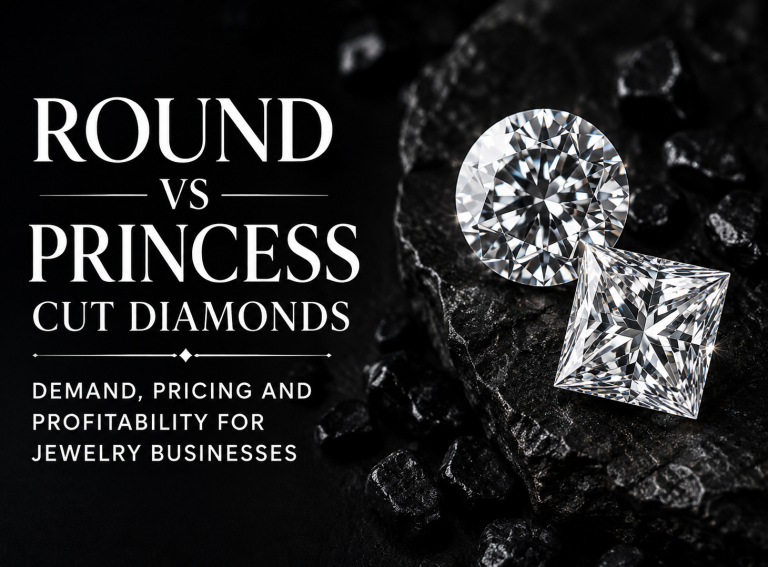
- Round Brilliant vs Princess Cut: Princess cuts have pointed corners that carry chip risk and show inclusions more easily near the edges. The round brilliant has better durability and stronger optical efficiency in most cutting scenarios.
- Round Brilliant vs Oval Cut: Oval cuts appear larger per carat because their elongated surface covers more visual space. A poorly proportioned oval shows a bow-tie shadow in the centre. The round brilliant has even symmetry in all directions that ovals simply cannot match.
- Round Brilliant vs Cushion Cut: Cushion cuts vary widely between cutters, making comparison harder for buyers sourcing across suppliers. The round brilliant is standardised enough that comparing two diamonds at the same cut grade is straightforward and reliable.
- Round Brilliant vs Emerald Cut: These are opposite choices. Emerald cuts are quiet and clarity-dependent. Round brilliants are built for brightness and movement. Buyers choosing between them are really choosing between two different personalities in a ring.
Best Settings for a Round Brilliant Cut Diamond
- Solitaire: Four or six prong solitaire settings let the diamond’s light performance carry the ring without distraction. This is still the most classic and most sold configuration in the engagement ring market.
- Halo: A surrounding ring of smaller lab grown diamonds amplifies the perceived size of the centre diamond. Halo settings with round brilliant centres are among the strongest selling engagement ring styles in the US market.
How to Choose the Best Round Brilliant Cut Diamond
Recommended Proportions for Maximum Light Performance
- Keep table size 54 to 58 percent and total depth 59 to 62.5 percent only.
- Crown angle 34 to 35 degrees and pavilion angle 40.6 to 41 degrees will give the best shine always.
Certification to Look For
- At Grown Diamond Corporation we use GCAL 8X to check real light, and IGI is also very good for 4Cs.
- Always check the certificate number on the lab website properly before taking diamond delivery.
Common Buying Mistakes to Avoid
- Taking top colour grade but cheap cut grade is the biggest mistake of buyers.
- A normal G colour with Excellent or GCAL 8X cut will always shine better than D colour with just Good cut.
Are Lab-Grown Round Brilliant Cut Diamonds Worth Buying?
- Appearance Compared to Natural Diamonds: They are exactly the same like natural diamonds only. If cut, colour and clarity are same, you will see zero difference between lab grown and mined diamond.
- Price Advantages: Lab grown round brilliant diamonds price is very less. Retailers can easily sell G colour, VS2 clarity and GCAL 8X verified round brilliant in good profit margin, giving best quality to buyers.
Who Should Choose a Round Brilliant Cut Diamond?
- Best for Engagement Rings: The round brilliant works in every setting, appeals to the widest range of buyers, and holds its visual appeal across every lighting condition. For engagement ring inventory it is the most commercially reliable option available.
- Best for Everyday Jewellery: Round diamond stud earrings and round brilliant pendants sell consistently at every price point. They require no trend alignment and remain strong sellers year after year.
Final Thoughts: Is a Round Brilliant Cut Diamond the Right Choice for You?
For most people, yes. Verified light performance, universal setting compatibility, strong commercial demand, and straightforward quality comparison make the round brilliant the most complete diamond cut in the market.
At Grown Diamond Corporation, our round cut lab grown diamonds carry GCAL 8X certification so you know exactly what you are receiving before any order is placed.