Microscopic vs. Visual Differences in Lab Grown Diamonds


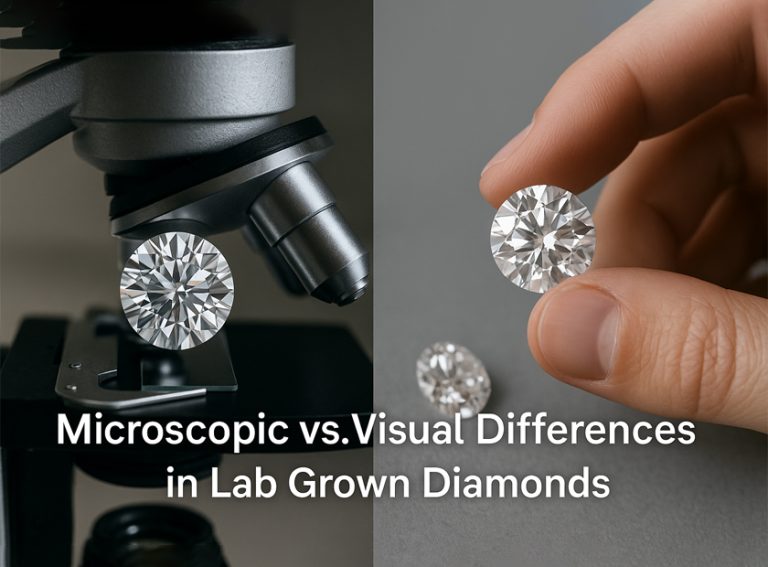
Identifying faults and inclusions in lab grown diamonds is extremely difficult for a lay man. Even with the use of special equipment, one will need the assistance of a diamond professional to spot inclusions.
However, at times, one may be able to spot visual differences with the naked eye. In this blog, we explore the microscopic and visual differences in lab grown diamonds. If you want to learn how to spot inclusions or the many characteristics of manmade diamonds, this blog is your guide.
Let’s get started!
How do Diamonds Form?
Real diamonds are created by two methods. One – natural diamonds that form under the surface of the Earth under natural circumstances. And two – lab grown diamonds that are created in laboratories. Man made diamonds are as real as naturally formed diamonds because they are created by replicating the process that creates natural diamonds.
Lab manufactured diamonds are created using two methods – High Pressure High Temperature (HPHT) and Chemical Vapor Deposition (CVD). Even though lab grown diamonds and naturally formed diamonds have the same chemical, physical, and visual properties, there are differences that you can spot when you see lab made diamonds with the naked eye and under the microscope.
Methods to Identify Diamond Characteristics
You can examine lab diamonds in two ways – visually and microscopically. In visual inspection, you can spot some inclusions, such as metallic or irregular coloration. You may even be able to spot growth patterns that are a result of the layered process of creating synthetic diamonds. Apart from that, graining diamonds can be a mark of lab grown diamonds.
In laser or microscopic inspection, one may be able to spot differences that are not visible through the naked eye. One can even read the inscription, among other details.
Microscopic Differences
Crystal Growth Patterns
When seen under a microscope, you can see the crystal growth patterns in lab grown diamonds. For instance, when made using the HPHT method, diamonds may display cubic growth patterns. These appear as straight growth lines. Moreover, these lab grown diamonds may contain elements such as iron, cobalt, or nickel, which can be seen under the microscope.
Lab made diamonds created using the CVD method show layered growth patterns. These are the different layers that appear during the growth process. These can be seen only under a microscope.
Fluorescence
When lab grown diamonds are exposed to ultraviolet light, it leads to fluorescence. HPHT man made diamonds typically show no or faint fluorescence as they are pure. CVD lab grown diamonds show a distinctive orange-red or green fluorescence.
Inclusions
HPHT lab made diamonds typically display inclusions of flux metals used in the process of creating them in the lab. These appear as dark spots. Moreover, these diamonds also show color zoning under certain lighting. On the other hand, CVD lab created diamonds display inclusions of graphite as well as hydrogen defects.
Visual Differences
In lab grown diamonds, one can sometimes see color distribution differences with naked eyes if the difference is stark. The crystal growth in HPHT lab created diamonds shows distinct color zoning. In CVD diamonds, one can see color banding, which is a result of its layer-by-layer growth process.
Clarity
Lab manufactured diamonds often display more organized inclusions and growth patterns, for instance, CVD lab grown diamonds often show stitching patterns.
Strain Patterns
Lab diamonds also display strain patterns. For example, cross-shaped strain patterns are common and reflect the layer-by-layer growth process of diamonds.
Diamond Tester Techniques
One can use various professionally used diamond testers, screening devices and equipment to identify diamond characteristics. For instance, these devices reveal whether a diamond is synthetic based on UV transparency. Professional diamond laboratories such as the Gemological Institute of America (GIA), International Gemological Institute (IGI), use various techniques and equipment along with human intelligence to spot diamond characteristics.
Girdle Inscriptions
Lab grown diamonds also have inscriptions on the girdle, which can be seen via the naked eye. However, at times, it may be difficult to read the inscriptions due to its small size. At such times, you may need equipment such as a microscope to read the inscriptions.
Summing up
The preference for lab grown diamonds is increasing. Customers not only buy them for its lower price and exceptional performance, but they are also investing time and effort in understanding their diamonds. For instance, they want to know the origin lab, the characteristics, the inclusions, etc.
While it is easy to spot details under microscopic equipment and with the help of professionals, spotting details with the naked eye has its limitations. If you’re looking to buy lab grown diamonds of good quality, explore the wide range by Grown Diamond Corporation.