Diamond Tester vs Diamond Screener: Whats the Difference and Which One Do You Need?


If you’re in the diamond industry, you must’ve often heard the words diamond screener and diamond tester. Well, often interchangeably.
Did you know there are many differences between the two diamond checkers: diamond screener and diamond tester? In this blog, we compare the two and understand everything you need to know about these tools.
What is a diamond tester?
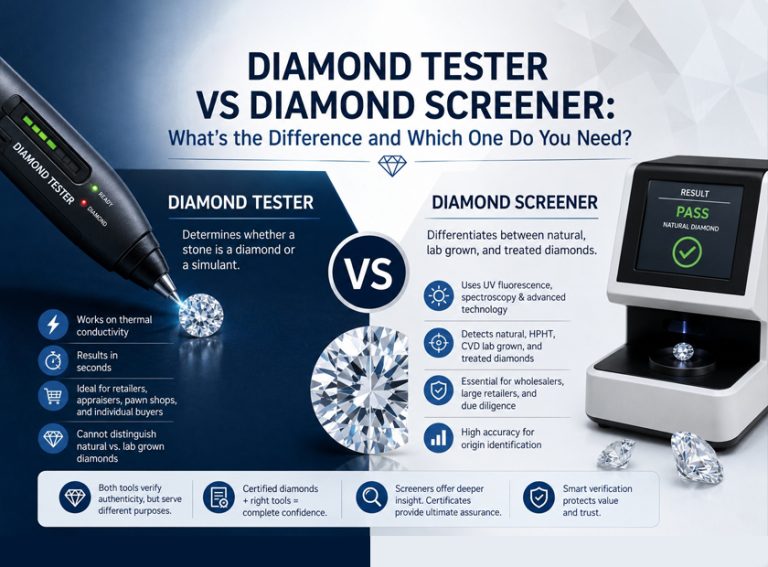
A diamond tester is a diamond checker instrument that helps determine whether a gemstone is a diamond or a non-diamond simulant. It is one of the most widely used tools in the jewelry industry. Most diamond testers are lightweight, battery-operated, and handheld. Diamond testers are designed for speed and convenience, not for deep analytical capability.
How does a diamond tester work?
While different diamond testers operate in different ways, the most common ones work on the principle of thermal conductivity. Diamonds are heat conductors. This means, a diamond dissipates heat when a heated probe tip touches its surface. The diamond tester measures the rate at which heat travels through the diamond. If the rate matches the diamond’s known thermal profile, the tester reads positive. Other diamond testers also include electrical conductivity testing. Diamond testers are available online.
What are diamond testers used for?
Diamond testers are used to ascertain diamond authenticity. Testers help understand whether a gemstone is a diamond or not. In the diamond market, diamond testers are used for these purposes:
-
For retail point-of-sale verification
-
To authenticate estate pieces
-
By pawn and secondhand dealers to assess jewelry before offering a price
-
By appraisers to conduct initial triage before committing to full gemological analysis
-
By consumers and individual buyers to get assurance before a purchase
However, a diamond tester cannot distinguish between a natural diamond and a lab grown diamond. Both will produce a positive reading because both are chemically, physically, and optically identical.
What is a diamond screener?
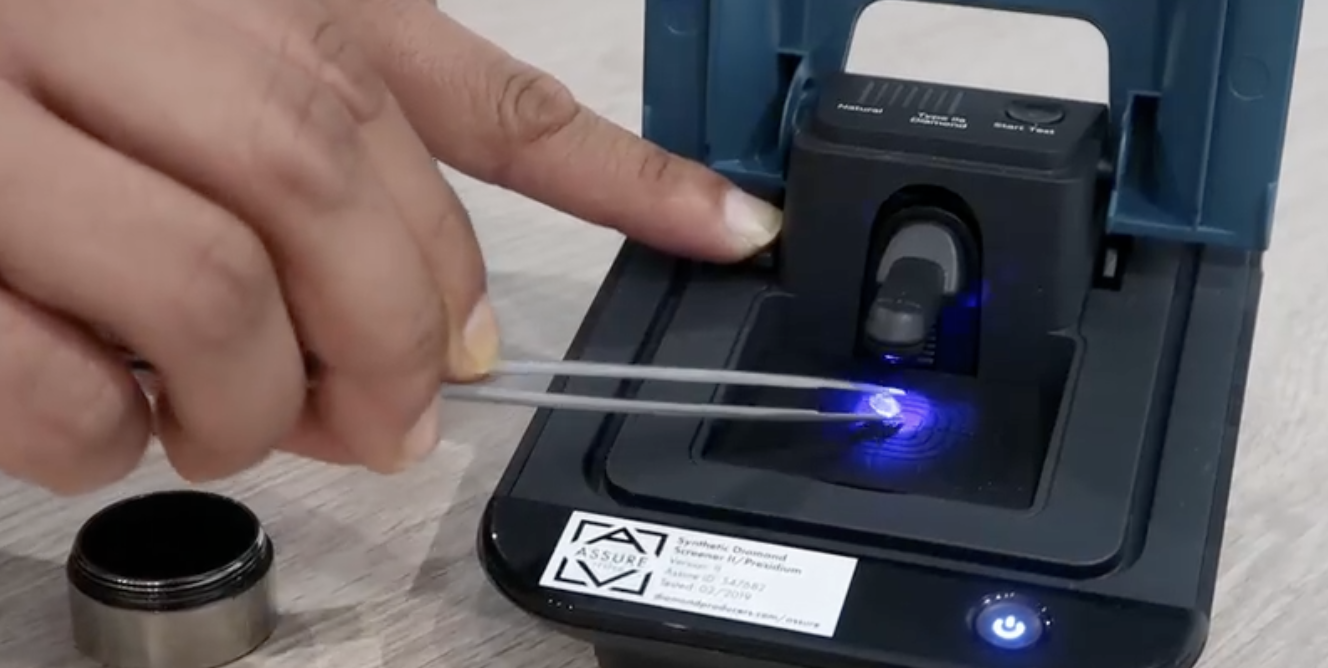
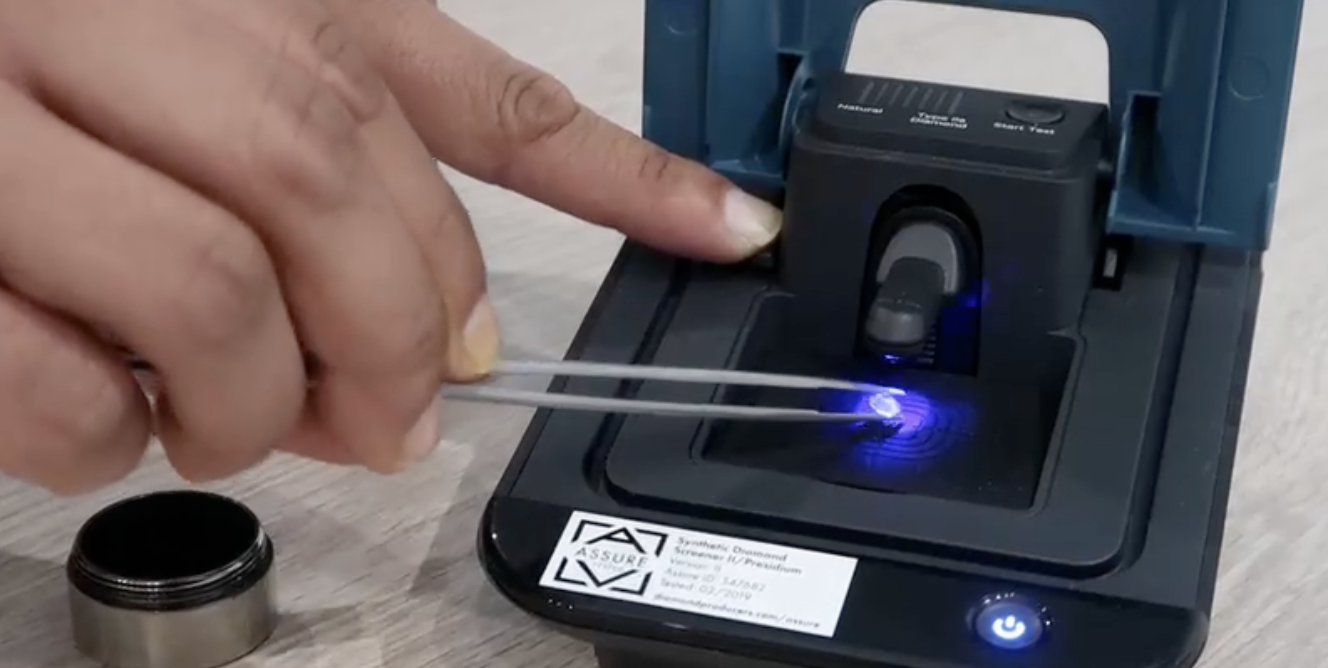
Compared to a diamond tester, a diamond screener is a more sophisticated instrument designed to go beyond simple identification. A diamond screener helps differentiate between types of diamonds, specifically between natural diamonds and lab grown diamonds. Additionally, this diamond checker also flags diamonds that may have undergone treatments that alter their appearance or value.
How does a diamond screener work?
Diamond screeners function using optical and spectroscopic technologies that analyze the atomic and crystallographic properties of a diamond. The most common technologies employed include:
-
Ultraviolet (UV) fluorescence and phosphorescence: Diamonds exhibit characteristic responses under specific UV wavelengths. HPHT diamonds and CVD diamonds often show distinct fluorescence and phosphorescence patterns that differ from natural diamonds.
-
Short-wave UV testing: Natural type IIa diamonds and most CVD lab grown diamonds are transparent to short-wave UV in different ways, allowing the screener to flag stones that need further examination.
-
Infrared (IR) and Raman spectroscopy: High-end diamond screeners use spectroscopic analysis to examine nitrogen impurities, crystal growth patterns, and other structural markers that reveal a diamond’s growth origin.
Most B2B-grade diamond screeners produce results in two categories: Pass (almost certainly natural) or Refer (requires further gemological analysis).
What is the purpose of diamond screening in diamond verification?
The rise of CVD and HPHT lab grown diamonds has created a verification challenge. Diamond testers are not enough to verify diamond type. For example, a 1-carat HPHT diamond and a 1-carat natural diamond are both identical, and hence, both pass the thermal diamond tester.
For wholesalers and retailers, diamond screeners are the most preferred equipment as it is a part of due diligence.
Types of diamonds a screener can identify
A quality diamond screener can differentiate or flag the following:
-
Natural diamonds: Diamonds formed over billions of years under the earth.
-
HPHT lab grown diamonds: Grown under high pressure and temperature mimicking natural conditions.
-
CVD lab grown diamonds: Grown through chemical vapor deposition, they typically show different UV phosphorescence.
-
HPHT treated diamonds: Natural diamonds subjected to HPHT processing to improve color. Diamond screeners flag for further analysis.
Diamond tester vs diamond screener: Key differences
|
Criteria |
Diamond tester |
Diamond screener |
|
Function |
Assess if it is a diamond or a simulant |
Identifies natural vs. grown vs. treated diamonds |
|
Method |
Thermal conductivity |
UV fluorescence, phosphorescence, spectroscopy |
|
Useful to |
Jewelry retailers, appraisers, pawn shops, consumers |
Wholesalers, graders, large retailers |
|
Testing speed |
Within seconds |
Within seconds to minutes |
|
Portability |
Handheld |
Bench-top, portable |
|
Lab grown detection |
Cannot detect |
Can detect, highly accurate |
|
Treated diamond detection |
Cannot detect |
Can detect |
Limitations of diamond testers and diamond screeners
Both types of diamond checkers—tester and screener—have limitations. Here are some:
False positives and negatives
Diamond testers can produce false positives on moissanite and on some synthetic materials with unusual conductivity profiles. Similarly, diamond screeners can misclassify diamonds. For example, a natural diamond can return a ‘Refer’ result. It can also result in false passes, where a lab grown diamond is classified as natural. No diamond screener guarantees zero error across all stone types and sizes.
Testing conditions that affect results
Both instruments are sensitive to testing conditions, such as the cleanliness of the diamond, ambient temperature, size, whether the diamond is mounted or loose, and the wear and tear on the instrument.
Why a diamond certificate still matters
Even with both a diamond tester and a diamond screener, gemological certification from a recognized grading laboratory (such as IGI, GCAL) remains the most important standard for diamonds.
Certification provides assurance of authenticity, traceability, origin, and quality grades of the diamonds, whether they are natural or lab grown diamonds. Diamond screeners and diamond testers are merely risk management tools.
The role of diamond checkers is verification – to confirm that the certificate matches the diamond, and that lab grown diamonds are separated from natural diamonds.
Summing up
Whether you should use a diamond tester or a diamond screener depends on the purpose. Most reputed lab grown diamond manufacturing brands, such as Grown Diamond Corporation use global standards for grading, testing, and screening diamonds.
Ensuring the right verification tool for diamonds is key. If you’re looking to buy authentic tested, screened, and graded lab grown diamonds, explore Grown Diamond Corporation.