What Is a Portuguese Cut Diamond? Everything You Need to Know (2026 Guide)


Many diamond buyers know about round, oval, cushion and emerald shapes only. But very few people heard about the Portuguese Cut Diamond. And almost nobody saw it in real life. This is not because it is a bad cut. It is because making it properly takes three times more hard work than a normal round diamond.
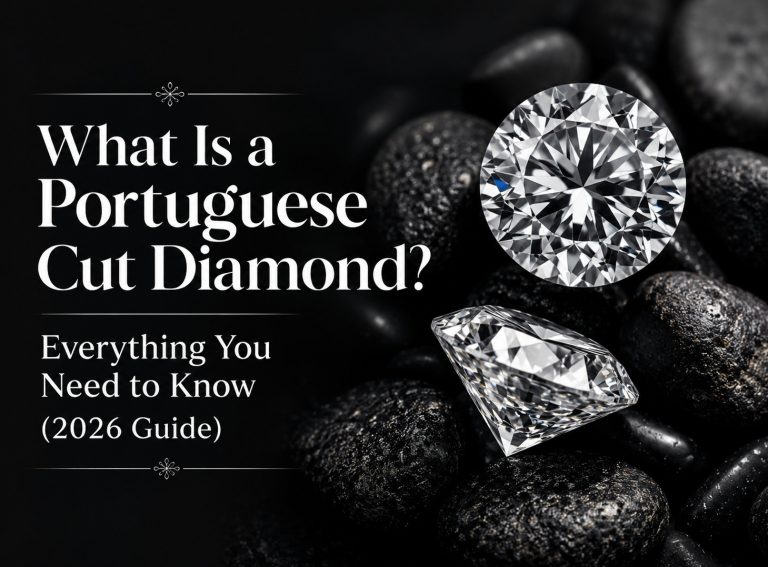
A Portuguese cut diamond has many lines of triangle and kite shape cuts on top and bottom both. A normal round diamond has only 57 or 58 cuts. But this one has 161 to more than 200 cuts, depending on maker design. Because of so many cuts, it gives so much fire and beautiful colors that modern diamonds can never match it.
What Is a Portuguese Cut Diamond?
Definition and Origin of the Portuguese Cut
The proper starting origin nobody knows, but in the 18th century it connected to Portugal. At that time Brazilian diamonds were only available there only. Makers there did many experiments on rough stone.
Why It Is Known for Exceptional Brilliance
Because it has 161 to 200 cuts, it throws more rainbow color flashes than round diamonds. In a warm light like a candle or dim restaurant, this Portuguese cut shines so much beautifully that modern diamonds just fail in front of it.
How It Differs from Standard Brilliant Cuts
A round brilliant is engineered to be consistent. Every diamond cut to ideal proportions performs in roughly the same way. The Portuguese cut lab diamond works on a different logic entirely. The many facets produce a kaleidoscope-like sparkle where light appears to swirl through the stone from different angles. You see different things every time the diamond moves.
History of the Portuguese Cut Diamond
Where the Cut Originated
During the 18th century, Brazil was the world’s leading source of diamonds and much of that rough passed through Lisbon before reaching European markets. Portuguese gem cutters had first access and enough craft tradition to push facet counts well beyond what was standard at the time.
Evolution from Antique Gemstone Cutting to Modern Precision
The Portuguese cut became particularly popular for colored gemstones such as amethyst, citrine, topaz, and quartz because its deep pavilion and numerous facets dramatically enhanced sparkle and color saturation. Over time, master cutters began applying the same faceting principles to diamonds. It was not an overnight shift. It happened gradually as cutters realised the same facet logic that made amethyst pop could do something extraordinary with diamond’s optical properties.
Why It Remains a Niche but Premium Diamond Cut
Cutting a Portuguese cut diamond takes significantly more time at the cutting wheel than a standard round brilliant. The price premium reflects the labor required to cut 161 facets with correct symmetry, not the material itself. That is why production stays low and availability stays limited even today.
Portuguese Cut Diamond Characteristics
Facet Count and Unique Faceting Pattern
An authentic Portuguese cut showcases a highly intricate pattern of facets, typically between 161 and 177 facets, far more than traditional cuts. These facets are arranged in multiple tiers or rows, forming a unique optical structure that maximises brilliance.
Shape, Symmetry, and Proportions
The diamond portuguese cut is applied almost always to a round outline. Oval or cushion versions are less common and often need to be specially sourced or custom cut. The pavilion runs deeper than a standard brilliant. This is important because it means the stone may face up slightly smaller than what the carat weight suggests on paper.
Fire vs. Brilliance: What Makes It Sparkle Differently
Brilliance is white light coming back out of the diamond. Fire is white light breaking into color as it exits. Round brilliants are optimised for brilliance. The Portuguese cut trades some of that clean white flash for more color dispersion. Under warm or ambient lighting the difference between the two is immediately obvious to anyone looking.
Common Carat Sizes
Many experts suggest that the Portuguese cut works best in larger stones, often around 2 carats or more, where the intricate faceting can show its full visual depth. Below 1 carat the facet pattern becomes harder to appreciate with the naked eye in most retail lighting conditions.
Portuguese Cut vs. Round Brilliant Cut
| Factor | Portuguese Cut | Round Brilliant |
| Facet count | 161 or more | 57 to 58 |
| Primary appeal | Fire and complexity | Brightness and uniformity |
| Availability | Specialty, limited | Widely available |
| Price premium | Higher due to cutting labor | Standard |
| Best setting | Solitaire, halo, vintage | Versatile across all settings |
The Portuguese cut has more facets and a deeper pavilion, resulting in more fire and dimension, while the round brilliant offers a more uniform sparkle. The customer choosing between these two is choosing between two completely different visual experiences.
Portuguese Cut vs. Other Popular Diamond Cuts
- Portuguese Cut vs. Oval Cut: Oval cuts are elongated brilliants built for white light return and a slimming visual effect on the finger. You are choosing between clean brightness and layered spectral fire when you compare the two.
- Portuguese Cut vs. Cushion Cut: Cushion cuts show decent fire but are far more standardized in production. The Portuguese cut is rarer, takes more labor, and gives you a more individual result.
- Portuguese Cut vs. Emerald Cut: These two are on opposite ends of the spectrum. Emerald cuts are step cuts built for clarity and a hall-of-mirrors reflection. Portuguese cuts maximize dispersion and facet complexity. Very different buyers choose each of these.
- Portuguese Cut vs. Asscher Cut: The Asscher is also a step cut, clean and geometric with a quiet elegance. The Portuguese cut is the more expressive choice in every way.
Pros and Cons of a Portuguese Cut Diamond
Advantages
- The fire this cut produces is genuinely unlike anything in the standard brilliant family.
- You get a diamond with real cutting heritage and visual character.
- Lab created diamonds make this style more accessible than it has ever been for retail customers and wholesalers who want a premium specialty product in their range.
Potential Drawbacks
- The deeper pavilion means you may pay for carat weight you cannot fully see face-up.
- Availability is limited, so sourcing takes more intention than ordering a standard round.
- Smaller sizes lose the visual impact that makes this cut worth choosing in the first place.
Who Should Consider This Cut
- Buyers who want something their customer has genuinely never seen before.
- Retailers who are building a specialty range and want a premium cut that most competitors are not carrying.
- Anyone who values craft and cutting history as part of what a diamond means.
How to Evaluate a Portuguese Cut Diamond Before Buying
Cut Quality and Symmetry
With 161 facets, symmetry problems show up immediately in the light pattern. You want Excellent or Very Good symmetry on the certificate, and you want scope images confirming the pattern is clean before you commit to a parcel.
Ideal Clarity and Color Grades
VS2 to VS1 is the practical clarity range for this cut. The deep pavilion can make inclusions more visible in certain viewing positions, so going lower than SI1 carries real risk. For color, G to H works well for most retail applications.
Certification and Grading Considerations
We use GCAL 8X certification for lab created diamonds at Grown Diamond Corporation. GCAL 8X verifies actual optical performance across eight parameters including brilliance, fire, and optical symmetry. For a cut where light performance is the entire reason someone chooses it, a performance-based certificate tells you far more than a proportions-based one ever could.
Best Jewelry Styles for Portuguese Cut Diamonds
- Solitaire settings let the facet complexity do the work without distraction.
- Halo settings amplify the fire with surrounding accent diamonds.
- Vintage and antique-inspired settings suit the cutting heritage naturally.
As a pendant the Portuguese cut performs especially well under warm indoor lighting where its fire is most visible to the wearer and everyone around them.
Are Portuguese Cut Diamonds More Expensive?
Yes, generally. The Portuguese cut loses more rough material during cutting due to its deeper pavilion and requires substantially more cutting time and expertise. These factors add cost per finished carat. Lab grown versions bring the material cost down significantly while the labor premium on the cutting side stays comparable to natural stone production.
Where to Buy a Portuguese Cut Diamond in 2026
At Grown Diamond Corporation, we have Portuguese cut lab diamond options certified to GCAL 8X standards. Every diamond is verified for optical performance before it leaves us, so you know exactly what you are receiving before the shipment arrives.
Before placing any order with any supplier, ask these questions directly.
- Is the diamond certified individually with a stone-level certificate?
- Does the certificate include optical symmetry and performance data?
- What is the replacement policy if the cut quality does not match the stated grade?
Final Thoughts: Is a Portuguese Cut Diamond Right for You?
If consistency and resale predictability are your main requirements, the round brilliant will serve you better. But if you want a diamond with genuine visual character, real cutting heritage, and a fire that most people have never seen in person, the Portuguese Cut Diamond is worth the extra sourcing effort.
We think so, and our customers who have added this cut to their range tend to agree.