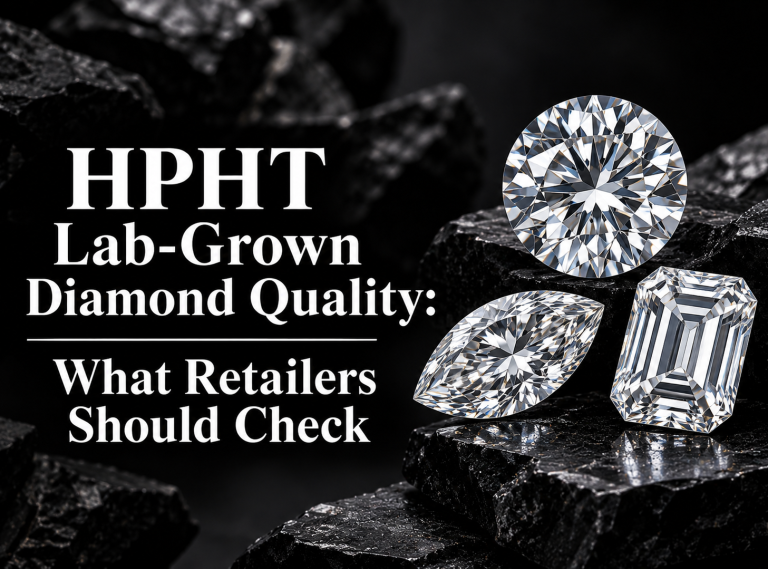
HPHT Lab-Grown Diamond Quality: What Retailers Should Check


Every HPHT lab-grown diamond starts in a press, where carbon dissolves into a hot metal bath and slowly settles onto a small diamond seed. It can reach D to F color as grown. But the certificate has to confirm it, and the price has to match.
Here is what retailers should check before ordering.
Why HPHT Lab-Grown Diamonds Are a Different Sourcing Conversation
D Color As-Grown
According to GIA, the press runs at 5 to 6 GPa and 1300 to 1600°C. GIA’s latest published review, from 2024, found over 90% of the HPHT diamonds sent to it in 2021 to 2023 were colorless.
Still, D is the top of the range, and plenty of HPHT diamonds come out below it. GIA says colorless HPHT is reportedly sold as grown, and a lab can only report no sign of treatment.
Batch Color Consistency
Batch consistency comes down to the grower. No lab study compares HPHT and CVD batches on color, so a supplier’s word needs proof behind it. Ask any supplier, us included, for color spreads from recent batches. Request the growth dates for each batch too, along with the share of diamonds graded D to F. A grower who tracks this will have the numbers ready.
The Quality Checklist: Three Things to Verify in Every HPHT Diamond
Lab-grown diamond quality on an HPHT report comes down to three catches.
Color and Treatment Status: An IGI report can say as grown, with no indication of post-growth treatment. That line records what the lab saw. It is no guarantee.
Since 2020, about 80% of all CVD diamonds sent to GIA have had post-growth processing. So, knowing this detail really matters when you are dealing with mixed parcels.
Plus, since October 1, 2025, GIA now assesses colorless lab-grown diamonds as either Premium or Standard. Their service page does not even mention the growth method or treatment at all. So, just make sure you always get both of those details in writing.
Clarity Status: Metallic flux inclusions are common in HPHT, and GIA says enough flux can make a diamond react to a magnet. No lab publishes the share of HPHT diamonds at VVS or better, so be wary of any supplier who quotes one.
Cut Status: GIA’s lab-grown assessment sets a cut requirement for round brilliants only. An oval or pear gets no GIA cut grade at all.
Where GCAL 8X Belongs in an HPHT Order
GCAL 8X means eight cut aspects, and a diamond needs Excellent in every one. GCAL 8X diamonds are rare by GCAL’s own count, since fewer than 1% of Excellent-cut round brilliants reach the grade. Nobody has audited that figure.
The bow-tie needs care. GIA research from Fall 2024 says elongated shapes almost always show one, and GCAL’s president described the goal as minimizing it. So 8X limits the bow-tie. It does not remove it.
The grade covers seven shapes, with emerald listed as coming soon. Among popular diamond shapes, oval leads in lab-grown center diamonds, according to The Knot.
Wholesale Pricing for HPHT Lab-Grown Diamonds in 2026
There is no proven price premium for HPHT. Edahn Golan’s Q3 2026 report says HPHT-grown diamonds trade at a discount, though it gives no figure. He adds that the majority of lab grown diamonds above 2 carats are CVD.
His list puts a 1 carat D VVS at $87 per carat and a G-H VS at $76. At 3 carats it is $142 against $78. So the color premium grows with size.
Paul Zimnisky’s May 2026 update puts retail markup above 80% over wholesale, as JCK reported. The margin depends on your buy price and what the certificate can prove.
Final Say
A lab report is the only proof of an as-grown color you can show a customer. Get the growth method in writing. Talk to the Grown Diamond Corporation (GDC) team about HPHT lab-grown diamond parcels.