Wholesale Lab-Grown Marquise Diamonds: A Buying Guide for U.S. Jewelry Retailers


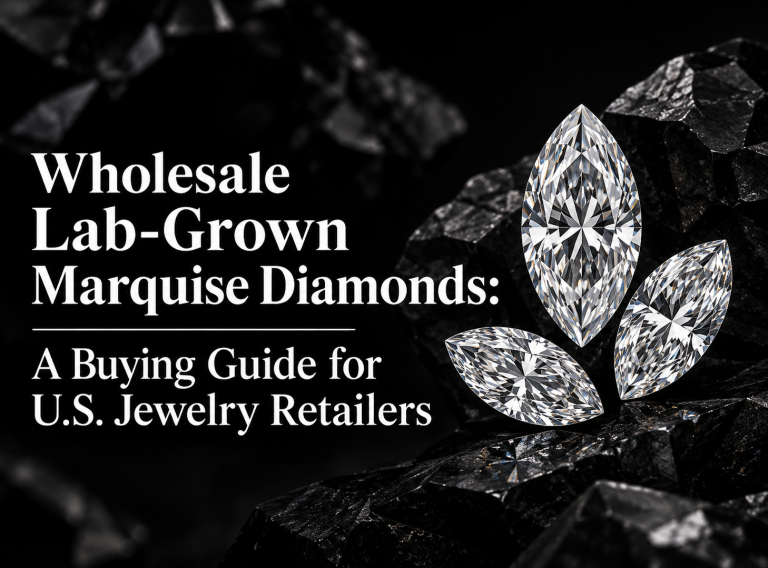
Lab grown marquise diamonds are now a regular part of wholesale orders for many U.S. retailers. In fact, the cut is no longer niche. The Knot’s 2026 Real Weddings study found 8% of couples who married in 2025 chose a marquise, the same share as emerald, pear and princess.
When you place a batch order, start with two checks. The first is how the diamonds were grown and what the cut certificate says. The second is your landed cost. And that number decides your actual margin.
Why U.S. Retailers Are Looking at Marquise
The U.S. retailers are now keeping and promoting a lot more of these marquise-cut diamonds. Because they have this long, football-like shape. This shape makes the diamond look much bigger than its real carat weight. And it also makes the person’s finger look much longer when they wear it.
What the 2025-2026 market data says
The Knot’s study shows 8% of couples who married in 2025 chose marquise engagement rings. Round stands at 26% and oval at 25%, so marquise is still a smaller slice of the market. Even so, Stuller’s Katelyn Meche told National Jeweler that emerald, marquise and elongated cushion cuts have increased the most in popularity over the past year. A sensible plan is to stock lab grown marquise cuts as a growing second line while round and oval stay your volume sellers.
The face-up size advantage
Many jewelers say a marquise covers more surface than a round of equal carat weight. The long outline is the reason. Rapaport reported this view from designers and retailers in October 2024. It is a trade opinion, so you should test it yourself. A good test is to place a well-cut 0.90 ct marquise next to a 1.00 ct round. Your customer will show you which one draws the eye first.
HPHT or CVD: Which Growth Method Should You Source?
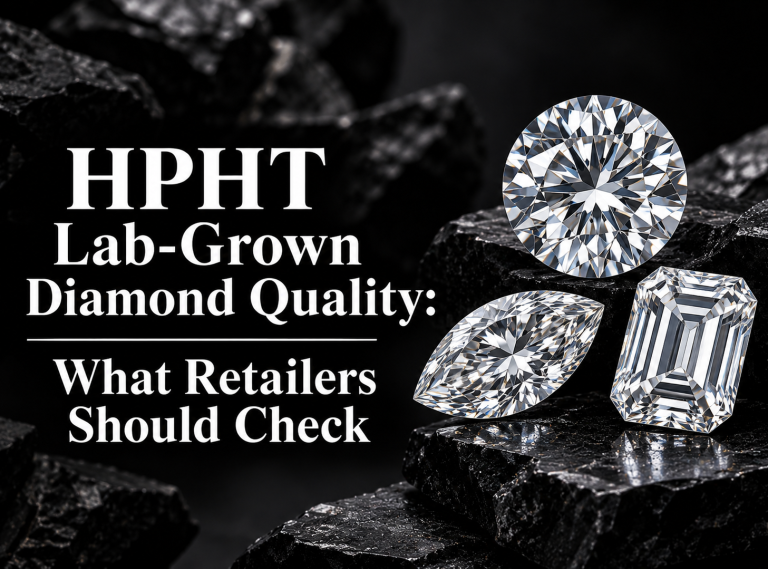
CVD grows diamonds using a carbon-rich gas. HPHT, on the other hand, uses extreme pressure and heat. Both lab grown diamond growth methods grow actual diamonds. Neither one gives you better grades by default. You must check the grading report on each stone and check if any post-growth treatment was done before you commit.
How CVD color treatment affects fancy-shape batches
According to GIA’s 2024 lab-grown update, CVD diamonds now make up most of the lab-grown diamonds submitted to GIA. About 80% of the CVD diamonds it received since 2020 had post-growth processing, and HPHT treatment to improve color is a common one. You should always check if your batch has these treated CVD stones and check their papers.
This does not mean every single CVD marquise is treated, or that treated diamonds are bad. Just check each fancy-shape diamond one by one. Because, one single batch label cannot tell you if a specific stone has a good face-up color or some bad dark spot in the middle.
Why HPHT delivers more consistent D–F color as-grown
Do not just assume that all HPHT diamonds are totally colorless, or that you will get perfect D-F color in the whole batch. GIA’s 2024 update says over 90% of the HPHT diamonds it received from 2021 to 2023 were colorless. This is GIA’s intake data and covers only part of the market, so you should still check each diamond’s color grade. That is why always check for the individual stone’s color grade and confirm if it got any post-growth treatment.
Cut Quality in Lab-Grown Marquise Diamonds: What Retailers Must Check
A grading report can tell you the basic diamond details. But, you must always check the marquise face-up yourself. Before you place any order, always ask for a clear video in normal lighting, the exact measurements, and a clear written return policy.
The bow-tie effect: What it is and how to spot it
Ever seen a dark patch across the middle of a marquise? That is the bow-tie effect. It is shaped like, well, a bow tie. GIA describes it in long brilliant cuts like this one. Every diamond shows it differently, and the length-to-width ratio will not tell you how strong it is, you know. So you should view each diamond face-up, from a normal distance. Then see if the dark center is blocking the sparkle.
Length-to-width ratio: The commercial sweet spot
What ratio should you order?
GIA’s consumer guide gives 1.75 to 2.25 as the usual range for a marquise. Its Gems & Gemology article goes wider, from 1.5 to 2.5. For wholesale orders, you can start inside the 1.75 to 2.25 band and narrow it after you see your own sell-through.
But the ratio alone will not tell you how strong the bow-tie is. So you should view every marquise face-up before it goes into your order.
Why GCAL 8X is the Most Complete Cut Certificate for Marquise
GIA does not give fancy shapes a cut grade, marquise included. It grades polish and symmetry for these shapes instead. IGI began cut grading for fancy shapes in September 2022, and its lab-grown marquise reports can show a cut grade.
GCAL launched the 8X Marquise in December 2024. The grade targets the bow-tie effect, a common cut issue in this shape. The certificate also has imaging and light performance documentation. So GCAL 8X adds cut information beyond a polish and symmetry grade. Stuller offers 8X marquise in lab-grown diamonds. GDC lists marquise diamonds and names IGI and GCAL as its grading labs, so you should contact our team about current stock and reports for your order.
Wholesale Pricing for Lab-Grown Marquise Diamonds in 2026
Why wholesale quotes vary
If you go looking for a lab-grown marquise diamond right now, you will never find a fixed rate. These wholesale prices change accordingly. It depends on your order value, and the collection you want to buy. Also, it depends on the carat weight, color, clarity, and even lab certificate.
What retailers should consider when comparing prices
A cheap wholesale quote is not automatically a good deal for your store. In fact, you need to check the face-up appearance, how fast this shape sells for you, and what the supplier’s return policy looks like if something goes wrong. And compare only matching stones. And always calculate your margin using total landed cost.
Common Sourcing Mistakes to Avoid
- Choosing by carat weight and ratio without checking how the diamond looks face-up.
- Treating a visible bow-tie as automatically unacceptable, or automatically harmless.
- Assuming CVD means brown or HPHT means D-F. Check the individual diamond and its documentation.
- Using round-diamond wholesale benchmarks as evidence of marquise prices.
- Promising higher margins without calculating landed cost and actual sell-through.
- Treating a certificate grade as a substitute for video, in-person inspection, or a workable return policy.