How to Interpret Diamond Imaging - ASET, IDEAL, Hearts & Arrows?
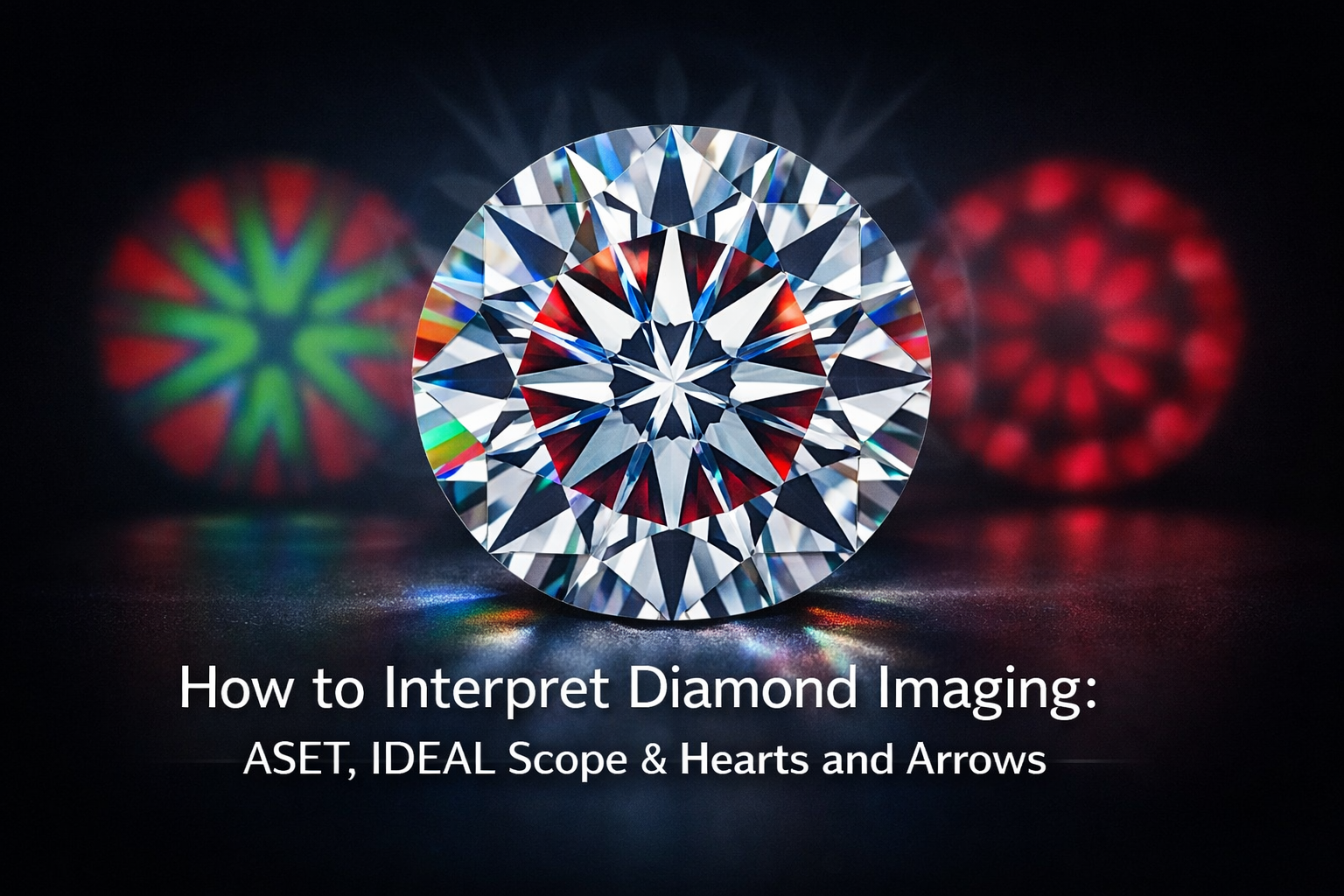

Diamond imaging methods visually assess how light performs within a diamond. Diamond imaging technologies include ASET, IDEAL Scope, and Hearts & Arrows patterns, among others.
Diamond imaging methods help verify diamonds’ optical performance, assessing how light performs in a diamond, where it enters, leaks, and how it reflects. By having an understanding of lab diamond cut and imaging methods, you can identify top-quality lab grown diamonds, and their various factors.
What is ASET imaging?
Angular Spectrum Evaluation Tool (ASET) diamond imaging involves colored filters to track how light enters a diamond from different angles. The technology was developed by the American Gem Society (AGC). It shows which facets lend brilliance and which leak light. The method involves a hemispherical reflector with colored zones around the diamond, and photographing it through the table.
Color meaning:
-
Red: Light entering from 45-75° angles (bright, intense, brilliant)
-
Green: Light from 0-45° angles (moderate brightness)
-
Blue: Shows light reflecting from beneath the diamond (contrast areas creating visual appeal)
-
White/leakage: Areas where light is escaping
-
Black: Obstruction from the viewer’s head and lighting environment
How to read an ASET Scope image?
-
Examine the color distribution across the lab grown diamond table and crown.
-
Look for symmetry in the color pattern. An even ASET image means precise cutting.
-
Random patches of leakage means there are alignment problems.
-
White leakage in the center of the table means the diamond is losing brightness potential.
-
Hold the ASET scope diamond image at an arm’s length to assess the overall red to green color ratio.
-
Look for white leakage areas under the table and around the girdle.
-
Check if the blue areas form a balanced pattern.
What is IDEAL Scope imaging?
IDEAL Scope diamond imaging is a method that shows how light return performs. It uses a red filter and displays light leakage as white areas. IDEAL Scope functions on a binary principle. Red indicates light returning, and white indicates light escaping, and black shows contrast areas where light is blocked. The tool includes a small scope to view the lab diamond cut and performance.
How to interpret IDEAL Scope results
-
Bright red: Excellent light return means proper angles and alignment for brilliance
-
Pale red: Moderate light return, not optimal performance
-
White areas: Direct light leakage
-
Black patterns: Contrast and obstruction areas that should form symmetrical patterns
-
Even color saturation: Consistent facet alignment and precision cutting
What are Hearts & Arrows diamonds?
Hearts & Arrows lab grown diamonds are precision-cut round brilliant. They display eight perfect hearts when viewed through the pavilion, and eight perfect arrows when viewed through the crown. Hearts & Arrows occurs only when all facets are cut to identical proportions. This pattern is a proof of symmetry, indicating the diamond’s light performance.
How to evaluate Hearts & Arrows patterns
Hearts pattern
-
All eight hearts are complete with clearly defined clefts at the top
-
Hearts are identical in size and shape
-
Hearts are evenly spaced in a perfect pattern
-
The V-shaped clefts point directly toward the center
-
Small triangular facets between hearts are symmetrical and uniform
Arrows pattern
-
Eight arrows have perfectly straight shafts of equal width
-
Arrow heads are symmetrical and uniform
-
Arrows point precisely toward the center
-
Spaces between arrows are equal and form consistent patterns
-
No minor facets are visible within the arrow shafts
-
The overall pattern creates a balanced appearance
Related Article - Hearts and arrows cut diamond pattern : What, Why, How, and More
ASET vs IDEAL vs Hearts & Arrows
Here is a comparison table of the different diamond imaging methods.
|
Feature
|
ASET
|
IDEAL
|
Hearts & Arrows
|
|
Purpose
|
Maps light angle contribution and leakage zones
|
Shows basic light return vs. leakage
|
Verifies precision symmetry and facet alignment
|
|
Ease of interpretation
|
Requires learning color meaning
|
Intuitive
|
Visual pattern matching
|
|
What it reveals
|
Exactly where light enters and from what angles
|
Whether light returns or leaks
|
Cut precision and consistency
|
|
Best suited for
|
Advanced buyers optimizing light performance
|
Quick assessment of cut quality
|
Verifying craftsmanship
|
|
Availability
|
Not common
|
Easily available
|
Speciality imaging required
|
Why diamond imaging is critical for lab grown diamonds
-
Lab diamonds vary in cut quality based on price point. Diamond imaging reveals the performance truth beyond certificate grades.
-
Some lab grown diamond manufacturers focus on carat weight over optical performance, but poor proportions. Diamond imaging can expose this.
-
An ‘Excellent’ lab diamond cut grade diamond can display performance variation. Diamond imaging technologies can differentiate this.
-
As lab grown diamonds are 30 to 50% cheaper than mined diamonds, one can demand imaging-verified performance.
-
Diamond imaging confirms that your specific lab grown diamond matches your desired quality, instead of relying on assumptions.
Wrapping up
Diamond imaging is essential and helps buy lab grown diamonds with confidence. If you’re looking for the best lab grown diamonds with certificates and diamond imaging results, explore Grown Diamond Corporation.
FAQs
1. What is diamond imaging and why is it important for lab grown diamonds?
Diamond imaging involves methods like ASET, IDEAL Scope, and Hearts & Arrows to visualize light performance and cut precision, revealing quality differences.
2. Why should buyers look at diamond imaging reports?
Diamond imaging reports reveal optical performance and light leakage that standard certifications miss.
3. What does ASET imaging show in a diamond?
ASET uses colored zones to map exactly where light enters the diamond, revealing which facets contribute to brilliance and which leak light.
4. What is an IDEAL Scope and what does it measure?
IDEAL Scope measures light return performance by showing red where light successfully reflects back and white where light leaks.
5. What makes a diamond Hearts and Arrows?
A Hearts & Arrows diamond has eight symmetrical hearts visible through the pavilion and eight symmetrical arrows through the crown, achieved through precision cutting.
6. Which diamond imaging method is best for lab grown diamonds?
ASET provides the most comprehensive performance data, but combining IDEAL Scope for quick light return assessment with Hearts & Arrows verification gives the most complete quality picture.
7. What are common errors when interpreting diamond images?
Focusing only on eliminating leakage rather than maximizing red zones in ASET, or assuming Hearts & Arrows guarantees optimal proportions.
{"AutoID":214,"DateCreation":"\/Date(1773309313947)\/","DateModified":"\/Date(1773309403323)\/","CreatedBy":null,"ModifiedBy":"Rahul Bohra","RecordStatus":"A","Title":"How to Interpret Diamond Imaging - ASET, IDEAL, Hearts \u0026 Arrows?","SubTitle":null,"Description":"\u003cp dir=\"ltr\"\u003eDiamond imaging methods visually assess how light performs within a diamond. Diamond imaging technologies include ASET, IDEAL Scope, and Hearts \u0026amp; Arrows patterns, among others.\u0026nbsp;\u003c/p\u003e\r\n\r\n\u003cp\u003e\u0026nbsp;\u003c/p\u003e\r\n\r\n\u003cp dir=\"ltr\"\u003eDiamond imaging methods help verify diamonds\u0026rsquo; optical performance, assessing how light performs in a diamond, where it enters, leaks, and how it reflects. By having an understanding of lab diamond cut and imaging methods, you can identify top-quality lab grown diamonds, and their various factors.\u003c/p\u003e\r\n\r\n\u003cp dir=\"ltr\"\u003e\u0026nbsp;\u003c/p\u003e\r\n\r\n\u003ch2 dir=\"ltr\"\u003e\u003cstrong\u003eWhat is ASET imaging?\u003c/strong\u003e\u003c/h2\u003e\r\n\r\n\u003cp dir=\"ltr\"\u003eAngular Spectrum Evaluation Tool (ASET) diamond imaging involves colored filters to track how light enters a diamond from different angles. The technology was developed by the American Gem Society (AGC). It shows which facets lend brilliance and which leak light. The method involves a hemispherical reflector with colored zones around the diamond, and photographing it through the table.\u003cstrong\u003e \u003c/strong\u003e\u003c/p\u003e\r\n\r\n\u003cp dir=\"ltr\"\u003e\u0026nbsp;\u003c/p\u003e\r\n\r\n\u003cp dir=\"ltr\"\u003eColor meaning:\u003c/p\u003e\r\n\r\n\u003cul\u003e\r\n\t\u003cli dir=\"ltr\"\u003e\r\n\t\u003cp dir=\"ltr\"\u003eRed: Light entering from 45-75\u0026deg; angles (bright, intense, brilliant)\u003c/p\u003e\r\n\t\u003c/li\u003e\r\n\t\u003cli dir=\"ltr\"\u003e\r\n\t\u003cp dir=\"ltr\"\u003e\u003ca href=\"https://www.growndiamondcorp.com/blog/green-diamonds-what-makes-them-so-stunning-and-sought-after/\"\u003eGreen\u003c/a\u003e: Light from 0-45\u0026deg; angles (moderate brightness)\u003c/p\u003e\r\n\t\u003c/li\u003e\r\n\t\u003cli dir=\"ltr\"\u003e\r\n\t\u003cp dir=\"ltr\"\u003e\u003ca href=\"https://www.growndiamondcorp.com/blog/a-look-into-the-world-of-lab-created-sapphires/\"\u003eBlue\u003c/a\u003e: Shows light reflecting from beneath the diamond (contrast areas creating visual appeal)\u003c/p\u003e\r\n\t\u003c/li\u003e\r\n\t\u003cli dir=\"ltr\"\u003e\r\n\t\u003cp dir=\"ltr\"\u003eWhite/leakage: Areas where light is escaping\u003c/p\u003e\r\n\t\u003c/li\u003e\r\n\t\u003cli dir=\"ltr\"\u003e\r\n\t\u003cp dir=\"ltr\"\u003e\u003ca href=\"https://www.growndiamondcorp.com/blog/lab-grown-black-diamonds-and-carbonados-where-and-how-to-buy/\"\u003eBlack\u003c/a\u003e: Obstruction from the viewer\u0026rsquo;s head and lighting environment\u003c/p\u003e\r\n\t\u003c/li\u003e\r\n\u003c/ul\u003e\r\n\r\n\u003ch2 dir=\"ltr\"\u003e\u003cstrong\u003eHow to read an ASET Scope image?\u003c/strong\u003e\u003c/h2\u003e\r\n\r\n\u003cul\u003e\r\n\t\u003cli dir=\"ltr\"\u003e\r\n\t\u003cp dir=\"ltr\"\u003eExamine the color distribution across the lab grown diamond table and crown.\u003c/p\u003e\r\n\t\u003c/li\u003e\r\n\t\u003cli dir=\"ltr\"\u003e\r\n\t\u003cp dir=\"ltr\"\u003eLook for symmetry in the color pattern. An even ASET image means precise cutting.\u003c/p\u003e\r\n\t\u003c/li\u003e\r\n\t\u003cli dir=\"ltr\"\u003e\r\n\t\u003cp dir=\"ltr\"\u003eRandom patches of leakage means there are alignment problems.\u0026nbsp;\u003c/p\u003e\r\n\t\u003c/li\u003e\r\n\t\u003cli dir=\"ltr\"\u003e\r\n\t\u003cp dir=\"ltr\"\u003eWhite leakage in the center of the table means the diamond is losing brightness potential.\u003c/p\u003e\r\n\t\u003c/li\u003e\r\n\t\u003cli dir=\"ltr\"\u003e\r\n\t\u003cp dir=\"ltr\"\u003eHold the ASET scope diamond image at an arm\u0026rsquo;s length to assess the overall red to green color ratio.\u003c/p\u003e\r\n\t\u003c/li\u003e\r\n\t\u003cli dir=\"ltr\"\u003e\r\n\t\u003cp dir=\"ltr\"\u003eLook for white leakage areas under the table and around the girdle.\u003c/p\u003e\r\n\t\u003c/li\u003e\r\n\t\u003cli dir=\"ltr\"\u003e\r\n\t\u003cp dir=\"ltr\"\u003eCheck if the blue areas form a balanced pattern.\u003c/p\u003e\r\n\t\u003c/li\u003e\r\n\u003c/ul\u003e\r\n\r\n\u003ch3 dir=\"ltr\"\u003e\u003cstrong\u003eWhat is IDEAL Scope imaging?\u003c/strong\u003e\u003c/h3\u003e\r\n\r\n\u003cp dir=\"ltr\"\u003eIDEAL Scope diamond imaging is a method that shows how light return performs. It uses a red filter and displays light leakage as white areas. IDEAL Scope functions on a binary principle. Red indicates light returning, and white indicates light escaping, and black shows contrast areas where light is blocked. The tool includes a small scope to view the lab diamond cut and performance.\u003c/p\u003e\r\n\r\n\u003ch3 dir=\"ltr\"\u003e\u003cstrong\u003eHow to interpret IDEAL Scope results\u003c/strong\u003e\u003c/h3\u003e\r\n\r\n\u003cul\u003e\r\n\t\u003cli dir=\"ltr\"\u003e\r\n\t\u003cp dir=\"ltr\"\u003e\u003cstrong\u003eBright red: \u003c/strong\u003eExcellent light return means proper angles and alignment for brilliance\u003c/p\u003e\r\n\t\u003c/li\u003e\r\n\t\u003cli dir=\"ltr\"\u003e\r\n\t\u003cp dir=\"ltr\"\u003e\u003cstrong\u003ePale red: \u003c/strong\u003eModerate light return, not optimal performance\u003c/p\u003e\r\n\t\u003c/li\u003e\r\n\t\u003cli dir=\"ltr\"\u003e\r\n\t\u003cp dir=\"ltr\"\u003e\u003cstrong\u003eWhite areas: \u003c/strong\u003eDirect light leakage\u003c/p\u003e\r\n\t\u003c/li\u003e\r\n\t\u003cli dir=\"ltr\"\u003e\r\n\t\u003cp dir=\"ltr\"\u003e\u003cstrong\u003eBlack patterns: \u003c/strong\u003eContrast and obstruction areas that should form symmetrical patterns\u003c/p\u003e\r\n\t\u003c/li\u003e\r\n\t\u003cli dir=\"ltr\"\u003e\r\n\t\u003cp dir=\"ltr\"\u003e\u003cstrong\u003eEven color saturation: \u003c/strong\u003eConsistent facet alignment and precision cutting\u003c/p\u003e\r\n\t\u003c/li\u003e\r\n\u003c/ul\u003e\r\n\r\n\u003cp dir=\"ltr\"\u003e\u0026nbsp;\u003c/p\u003e\r\n\r\n\u003ch2 dir=\"ltr\"\u003e\u003cstrong\u003eWhat are Hearts \u0026amp; Arrows diamonds?\u003c/strong\u003e\u003c/h2\u003e\r\n\r\n\u003cp dir=\"ltr\"\u003eHearts \u0026amp; Arrows lab grown diamonds are precision-cut round brilliant. They display eight perfect hearts when viewed through the pavilion, and eight perfect arrows when viewed through the crown. Hearts \u0026amp; Arrows occurs only when all facets are cut to identical proportions. This pattern is a proof of symmetry, indicating the diamond\u0026rsquo;s light performance.\u003cstrong\u003e \u003c/strong\u003e\u003c/p\u003e\r\n\r\n\u003ch3 dir=\"ltr\"\u003e\u003cstrong\u003eHow to evaluate Hearts \u0026amp; Arrows patterns\u003c/strong\u003e\u003c/h3\u003e\r\n\r\n\u003cp dir=\"ltr\"\u003e\u003cstrong\u003eHearts pattern\u003c/strong\u003e\u003c/p\u003e\r\n\r\n\u003cul\u003e\r\n\t\u003cli dir=\"ltr\"\u003e\r\n\t\u003cp dir=\"ltr\"\u003eAll eight hearts are complete with clearly defined clefts at the top\u003c/p\u003e\r\n\t\u003c/li\u003e\r\n\t\u003cli dir=\"ltr\"\u003e\r\n\t\u003cp dir=\"ltr\"\u003eHearts are identical in size and shape\u0026nbsp;\u003c/p\u003e\r\n\t\u003c/li\u003e\r\n\t\u003cli dir=\"ltr\"\u003e\r\n\t\u003cp dir=\"ltr\"\u003eHearts are evenly spaced in a perfect pattern\u003c/p\u003e\r\n\t\u003c/li\u003e\r\n\t\u003cli dir=\"ltr\"\u003e\r\n\t\u003cp dir=\"ltr\"\u003eThe V-shaped clefts point directly toward the center\u003c/p\u003e\r\n\t\u003c/li\u003e\r\n\t\u003cli dir=\"ltr\"\u003e\r\n\t\u003cp dir=\"ltr\"\u003eSmall triangular facets between hearts are symmetrical and uniform\u003c/p\u003e\r\n\t\u003c/li\u003e\r\n\u003c/ul\u003e\r\n\r\n\u003cp dir=\"ltr\"\u003e\u003cstrong\u003eArrows pattern\u003c/strong\u003e\u003c/p\u003e\r\n\r\n\u003cul\u003e\r\n\t\u003cli dir=\"ltr\"\u003e\r\n\t\u003cp dir=\"ltr\"\u003eEight arrows have perfectly straight shafts of equal width\u003c/p\u003e\r\n\t\u003c/li\u003e\r\n\t\u003cli dir=\"ltr\"\u003e\r\n\t\u003cp dir=\"ltr\"\u003eArrow heads are symmetrical and uniform\u0026nbsp;\u003c/p\u003e\r\n\t\u003c/li\u003e\r\n\t\u003cli dir=\"ltr\"\u003e\r\n\t\u003cp dir=\"ltr\"\u003eArrows point precisely toward the center\u0026nbsp;\u003c/p\u003e\r\n\t\u003c/li\u003e\r\n\t\u003cli dir=\"ltr\"\u003e\r\n\t\u003cp dir=\"ltr\"\u003eSpaces between arrows are equal and form consistent patterns\u003c/p\u003e\r\n\t\u003c/li\u003e\r\n\t\u003cli dir=\"ltr\"\u003e\r\n\t\u003cp dir=\"ltr\"\u003eNo minor facets are visible within the arrow shafts\u0026nbsp;\u003c/p\u003e\r\n\t\u003c/li\u003e\r\n\t\u003cli dir=\"ltr\"\u003e\r\n\t\u003cp dir=\"ltr\"\u003eThe overall pattern creates a balanced appearance\u003c/p\u003e\r\n\t\u003c/li\u003e\r\n\u003c/ul\u003e\r\n\r\n\u003cp dir=\"ltr\"\u003eRelated Article - \u003ca href=\"https://www.growndiamondcorp.com/blog/hearts-and-arrows-diamonds-what-why-how-and-more/\"\u003eHearts and arrows cut diamond pattern : What, Why, How, and More\u003c/a\u003e\u003c/p\u003e\r\n\r\n\u003cp dir=\"ltr\"\u003e\u0026nbsp;\u003c/p\u003e\r\n\r\n\u003ch2 dir=\"ltr\"\u003e\u003cstrong\u003eASET vs IDEAL vs Hearts \u0026amp; Arrows\u003c/strong\u003e\u003c/h2\u003e\r\n\r\n\u003cp dir=\"ltr\"\u003eHere is a comparison table of the different diamond imaging methods.\u003c/p\u003e\r\n\r\n\u003cp dir=\"ltr\"\u003e\u0026nbsp;\u003c/p\u003e\r\n\r\n\u003ctable\u003e\r\n\t\u003ctbody\u003e\r\n\t\t\u003ctr\u003e\r\n\t\t\t\u003ctd\u003e\r\n\t\t\t\u003cp dir=\"ltr\"\u003e\u003cstrong\u003eFeature\u003c/strong\u003e\u003c/p\u003e\r\n\t\t\t\u003c/td\u003e\r\n\t\t\t\u003ctd\u003e\r\n\t\t\t\u003cp dir=\"ltr\"\u003e\u003cstrong\u003eASET\u003c/strong\u003e\u003c/p\u003e\r\n\t\t\t\u003c/td\u003e\r\n\t\t\t\u003ctd\u003e\r\n\t\t\t\u003cp dir=\"ltr\"\u003e\u003cstrong\u003eIDEAL\u003c/strong\u003e\u003c/p\u003e\r\n\t\t\t\u003c/td\u003e\r\n\t\t\t\u003ctd\u003e\r\n\t\t\t\u003cp dir=\"ltr\"\u003e\u003cstrong\u003eHearts \u0026amp; Arrows\u003c/strong\u003e\u003c/p\u003e\r\n\t\t\t\u003c/td\u003e\r\n\t\t\u003c/tr\u003e\r\n\t\t\u003ctr\u003e\r\n\t\t\t\u003ctd\u003e\r\n\t\t\t\u003cp dir=\"ltr\"\u003ePurpose\u003c/p\u003e\r\n\t\t\t\u003c/td\u003e\r\n\t\t\t\u003ctd\u003e\r\n\t\t\t\u003cp dir=\"ltr\"\u003eMaps light angle contribution and leakage zones\u003c/p\u003e\r\n\t\t\t\u003c/td\u003e\r\n\t\t\t\u003ctd\u003e\r\n\t\t\t\u003cp dir=\"ltr\"\u003eShows basic light return vs. leakage\u003c/p\u003e\r\n\t\t\t\u003c/td\u003e\r\n\t\t\t\u003ctd\u003e\r\n\t\t\t\u003cp dir=\"ltr\"\u003eVerifies precision symmetry and facet alignment\u003c/p\u003e\r\n\t\t\t\u003c/td\u003e\r\n\t\t\u003c/tr\u003e\r\n\t\t\u003ctr\u003e\r\n\t\t\t\u003ctd\u003e\r\n\t\t\t\u003cp dir=\"ltr\"\u003eEase of interpretation\u003c/p\u003e\r\n\t\t\t\u003c/td\u003e\r\n\t\t\t\u003ctd\u003e\r\n\t\t\t\u003cp dir=\"ltr\"\u003eRequires learning color meaning\u003c/p\u003e\r\n\t\t\t\u003c/td\u003e\r\n\t\t\t\u003ctd\u003e\r\n\t\t\t\u003cp dir=\"ltr\"\u003eIntuitive\u0026nbsp;\u003c/p\u003e\r\n\t\t\t\u003c/td\u003e\r\n\t\t\t\u003ctd\u003e\r\n\t\t\t\u003cp dir=\"ltr\"\u003eVisual pattern matching\u003c/p\u003e\r\n\t\t\t\u003c/td\u003e\r\n\t\t\u003c/tr\u003e\r\n\t\t\u003ctr\u003e\r\n\t\t\t\u003ctd\u003e\r\n\t\t\t\u003cp dir=\"ltr\"\u003eWhat it reveals\u003c/p\u003e\r\n\t\t\t\u003c/td\u003e\r\n\t\t\t\u003ctd\u003e\r\n\t\t\t\u003cp dir=\"ltr\"\u003eExactly where light enters and from what angles\u003c/p\u003e\r\n\t\t\t\u003c/td\u003e\r\n\t\t\t\u003ctd\u003e\r\n\t\t\t\u003cp dir=\"ltr\"\u003eWhether light returns or leaks\u003c/p\u003e\r\n\t\t\t\u003c/td\u003e\r\n\t\t\t\u003ctd\u003e\r\n\t\t\t\u003cp dir=\"ltr\"\u003eCut precision and consistency\u003c/p\u003e\r\n\t\t\t\u003c/td\u003e\r\n\t\t\u003c/tr\u003e\r\n\t\t\u003ctr\u003e\r\n\t\t\t\u003ctd\u003e\r\n\t\t\t\u003cp dir=\"ltr\"\u003eBest suited for\u003c/p\u003e\r\n\t\t\t\u003c/td\u003e\r\n\t\t\t\u003ctd\u003e\r\n\t\t\t\u003cp dir=\"ltr\"\u003eAdvanced buyers optimizing light performance\u003c/p\u003e\r\n\t\t\t\u003c/td\u003e\r\n\t\t\t\u003ctd\u003e\r\n\t\t\t\u003cp dir=\"ltr\"\u003eQuick assessment of cut quality\u003c/p\u003e\r\n\t\t\t\u003c/td\u003e\r\n\t\t\t\u003ctd\u003e\r\n\t\t\t\u003cp dir=\"ltr\"\u003eVerifying craftsmanship\u0026nbsp;\u003c/p\u003e\r\n\t\t\t\u003c/td\u003e\r\n\t\t\u003c/tr\u003e\r\n\t\t\u003ctr\u003e\r\n\t\t\t\u003ctd\u003e\r\n\t\t\t\u003cp dir=\"ltr\"\u003eAvailability\u0026nbsp;\u003c/p\u003e\r\n\t\t\t\u003c/td\u003e\r\n\t\t\t\u003ctd\u003e\r\n\t\t\t\u003cp dir=\"ltr\"\u003eNot common\u003c/p\u003e\r\n\t\t\t\u003c/td\u003e\r\n\t\t\t\u003ctd\u003e\r\n\t\t\t\u003cp dir=\"ltr\"\u003eEasily available\u003c/p\u003e\r\n\t\t\t\u003c/td\u003e\r\n\t\t\t\u003ctd\u003e\r\n\t\t\t\u003cp dir=\"ltr\"\u003eSpeciality imaging required\u003c/p\u003e\r\n\t\t\t\u003c/td\u003e\r\n\t\t\u003c/tr\u003e\r\n\t\u003c/tbody\u003e\r\n\u003c/table\u003e\r\n\r\n\u003cp\u003e\u0026nbsp;\u003c/p\u003e\r\n\r\n\u003ch2\u003e\u003cstrong\u003eWhy diamond imaging is critical for lab grown diamonds\u003c/strong\u003e\u003c/h2\u003e\r\n\r\n\u003cul\u003e\r\n\t\u003cli dir=\"ltr\"\u003e\r\n\t\u003cp dir=\"ltr\"\u003e\u003ca href=\"https://www.growndiamondcorp.com/blog/lab-grown-diamonds-cut-vs-clarity-what-matters-most/\"\u003eLab diamonds vary in cut\u003c/a\u003e quality based on price point. Diamond imaging reveals the performance truth beyond certificate grades.\u003c/p\u003e\r\n\t\u003c/li\u003e\r\n\t\u003cli dir=\"ltr\"\u003e\r\n\t\u003cp dir=\"ltr\"\u003eSome \u003ca href=\"https://www.growndiamondcorp.com/\"\u003elab grown diamond manufacturers\u003c/a\u003e focus on carat weight over optical performance, but poor proportions. Diamond imaging can expose this.\u0026nbsp;\u003c/p\u003e\r\n\t\u003c/li\u003e\r\n\t\u003cli dir=\"ltr\"\u003e\r\n\t\u003cp dir=\"ltr\"\u003eAn \u0026lsquo;Excellent\u0026rsquo; lab diamond cut grade diamond can display performance variation. Diamond imaging technologies can differentiate this.\u003c/p\u003e\r\n\t\u003c/li\u003e\r\n\t\u003cli dir=\"ltr\"\u003e\r\n\t\u003cp dir=\"ltr\"\u003eAs lab grown diamonds are 30 to 50% cheaper than mined diamonds, one can demand imaging-verified performance.\u0026nbsp;\u003c/p\u003e\r\n\t\u003c/li\u003e\r\n\t\u003cli dir=\"ltr\"\u003e\r\n\t\u003cp dir=\"ltr\"\u003eDiamond imaging confirms that your specific lab grown diamond matches your desired quality, instead of relying on assumptions.\u003c/p\u003e\r\n\t\u003c/li\u003e\r\n\u003c/ul\u003e\r\n\r\n\u003cp dir=\"ltr\"\u003e\u0026nbsp;\u003c/p\u003e\r\n\r\n\u003ch2 dir=\"ltr\"\u003e\u003cstrong\u003eWrapping up\u003c/strong\u003e\u003c/h2\u003e\r\n\r\n\u003cp dir=\"ltr\"\u003eDiamond imaging is essential and helps buy lab grown diamonds with confidence. If you\u0026rsquo;re looking for the best lab grown diamonds with certificates and diamond imaging results, explore \u003ca href=\"https://www.growndiamondcorp.com/\"\u003eGrown Diamond Corporation\u003c/a\u003e.\u003c/p\u003e\r\n\r\n\u003cp dir=\"ltr\"\u003e\u0026nbsp;\u003c/p\u003e\r\n\r\n\u003ch2 dir=\"ltr\"\u003e\u003cstrong\u003eFAQs\u003c/strong\u003e\u003c/h2\u003e\r\n\r\n\u003cp dir=\"ltr\"\u003e\u003cstrong\u003e1. What is diamond imaging and why is it important for lab grown diamonds?\u0026nbsp;\u003c/strong\u003e\u003c/p\u003e\r\n\r\n\u003cp dir=\"ltr\"\u003eDiamond imaging involves methods like ASET, IDEAL Scope, and Hearts \u0026amp; Arrows to visualize light performance and cut precision, revealing quality differences.\u003c/p\u003e\r\n\r\n\u003cp\u003e\u0026nbsp;\u003c/p\u003e\r\n\r\n\u003cp dir=\"ltr\"\u003e\u003cstrong\u003e2. Why should buyers look at diamond imaging reports?\u0026nbsp;\u003c/strong\u003e\u003c/p\u003e\r\n\r\n\u003cp dir=\"ltr\"\u003eDiamond imaging reports reveal optical performance and light leakage that standard certifications miss.\u003c/p\u003e\r\n\r\n\u003cp\u003e\u0026nbsp;\u003c/p\u003e\r\n\r\n\u003cp dir=\"ltr\"\u003e\u003cstrong\u003e3. What does ASET imaging show in a diamond?\u0026nbsp;\u003c/strong\u003e\u003c/p\u003e\r\n\r\n\u003cp dir=\"ltr\"\u003eASET uses colored zones to map exactly where light enters the diamond, revealing which facets contribute to brilliance and which leak light.\u003c/p\u003e\r\n\r\n\u003cp\u003e\u0026nbsp;\u003c/p\u003e\r\n\r\n\u003cp dir=\"ltr\"\u003e\u003cstrong\u003e4. What is an IDEAL Scope and what does it measure?\u0026nbsp;\u003c/strong\u003e\u003c/p\u003e\r\n\r\n\u003cp dir=\"ltr\"\u003eIDEAL Scope measures light return performance by showing red where light successfully reflects back and white where light leaks.\u003c/p\u003e\r\n\r\n\u003cp\u003e\u0026nbsp;\u003c/p\u003e\r\n\r\n\u003cp dir=\"ltr\"\u003e\u003cstrong\u003e5. What makes a diamond Hearts and Arrows?\u0026nbsp;\u003c/strong\u003e\u003c/p\u003e\r\n\r\n\u003cp dir=\"ltr\"\u003eA Hearts \u0026amp; Arrows diamond has eight symmetrical hearts visible through the pavilion and eight symmetrical arrows through the crown, achieved through precision cutting.\u003c/p\u003e\r\n\r\n\u003cp\u003e\u0026nbsp;\u003c/p\u003e\r\n\r\n\u003cp dir=\"ltr\"\u003e\u003cstrong\u003e6. Which diamond imaging method is best for lab grown diamonds?\u0026nbsp;\u003c/strong\u003e\u003c/p\u003e\r\n\r\n\u003cp dir=\"ltr\"\u003eASET provides the most comprehensive performance data, but combining IDEAL Scope for quick light return assessment with Hearts \u0026amp; Arrows verification gives the most complete quality picture.\u003c/p\u003e\r\n\r\n\u003cp\u003e\u0026nbsp;\u003c/p\u003e\r\n\r\n\u003cp dir=\"ltr\"\u003e\u003cstrong\u003e7. What are common errors when interpreting diamond images?\u0026nbsp;\u003c/strong\u003e\u003c/p\u003e\r\n\r\n\u003cp dir=\"ltr\"\u003eFocusing only on eliminating leakage rather than maximizing red zones in ASET, or assuming Hearts \u0026amp; Arrows guarantees optimal proportions.\u003c/p\u003e\r\n","FromDate":null,"ToDate":null,"Image_Url":"lab-grown-diamond-imaging-aset-ideal-hearts-arrows.png","Image_Alt":null,"KeyWords":null,"MetaDescription":"Understand ASET, IDEAL Scope, and Hearts \u0026 Arrows diamond imaging to identify superior light performance, symmetry, and cut precision in lab grown diamonds.Diamond imaging methods visually assess how light performs within a diamond. Diamond imaging technologies include ASET, IDEAL Scope, and Hearts \u0026 Arrows patterns, among others. Diamond imaging methods help verify diamonds’ optical performance, assessing how light performs in a diamond, where it enters, leaks, and how it reflects. By having an understanding of lab diamond cut and imaging methods, you can identify top-quality lab grown diamonds, and their various factors.","MetaTitle":"Diamond Imaging - ASET, IDEAL, Hearts \u0026 Arrows","CanonicalLink":null,"MetaContent":null,"SeqNo":null,"Slug":"lab-grown-diamond-imaging-aset-ideal-hearts-arrows","GetTitle":"how-to-interpret-diamond-imaging-aset-ideal-hearts-arrows","GetImageUrl":"https://docs.growndiamondcorp.com/blog/lab-grown-diamond-imaging-aset-ideal-hearts-arrows.png"}