Round vs Princess Cut Diamonds: Demand, Pricing and Profitability for Jewelry Businesses


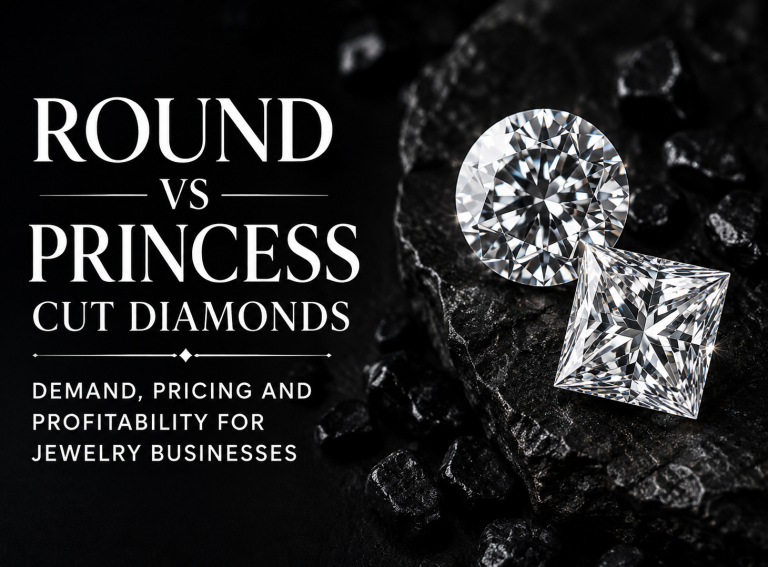
Round diamonds hold roughly 75% of all US diamond sales. Princess cut sits around 8% globally. Two very different numbers and both matter before you source anything.
But market share is only part of the picture on round vs princess cut diamonds. Who is buying, what margin looks like, and what your customer actually asks for when they walk in. All of that changes which cut makes more sense for your specific business.
Round Cut vs Princess Cut Diamonds: A Quick Comparison
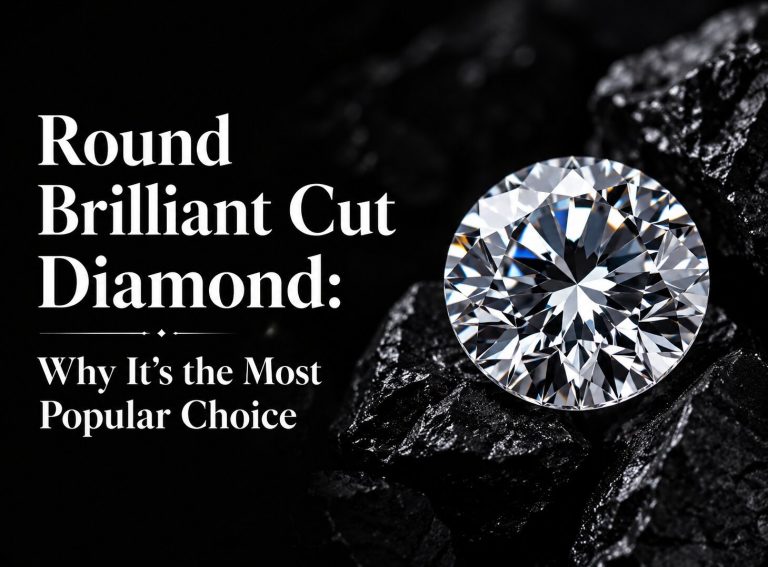
Cutting a round brilliant costs roughly 50 to 60% of the original rough. That loss never leaves the price. It is why round diamonds cost more per carat than any other shape, regardless of quality level.
The princess cut is different. Chevron-shaped pavilion facets, 57 of them, scatter light into smaller geometric flashes. The square shape keeps up to 90% of the rough crystal. That yield advantage is why princess cuts diamonds typically run 20 to 40% less per carat than a comparable round.
Brilliance is strong in both. What changes is the character of it. Rounds return light evenly across the whole face. Princess cuts give a more contrasted, geometric pattern. Neither is wrong. They just find different buyers and knowing which buyer you are talking to is where good sourcing decisions start.
| Factor | Round Brilliant | Princess Cut |
| Market share (US) | ~75% of sales | ~8% of global market |
| Price per carat | 15-30% premium over princess | 20-40% lower than round |
| Rough diamond yield | 45-50% | Up to 90% |
| Brilliance style | Uniform, maximum brightness | Geometric, dispersed flashes |
| Corner vulnerability | None | Requires protective prong setting |
| Growth forecast (to 2030) | 4.3% CAGR | 3.5% CAGR |
Current Market Demand for Round vs Princess Cut Diamonds
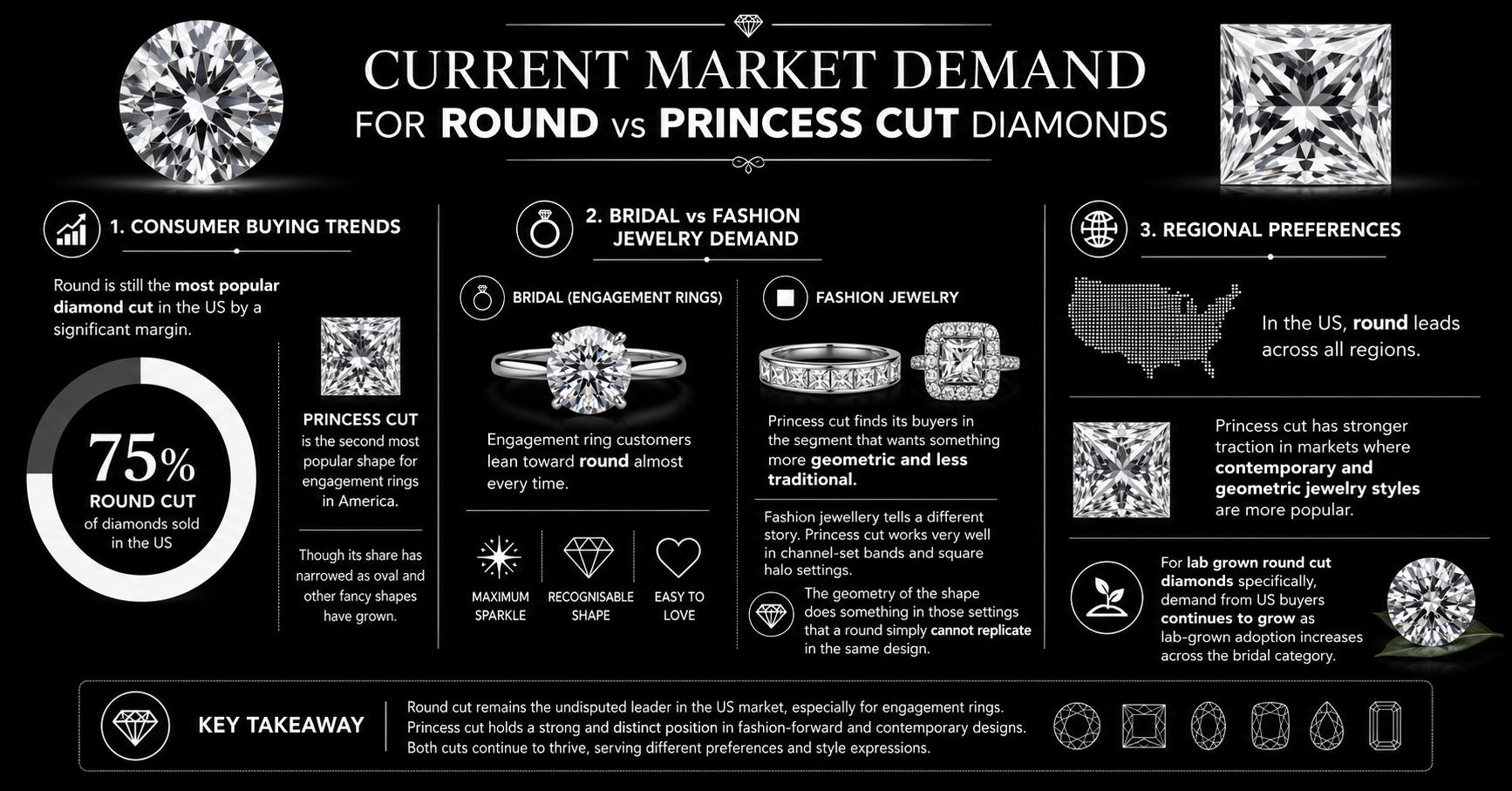
Consumer Buying Trends
Round is still the most popular diamond cut in the US by a significant margin. It accounts for approximately 75% of diamonds sold domestically. Princess cut is the second most popular shape for engagement rings in America, though its share has narrowed as oval and other fancy shapes have grown.
Bridal vs Fashion Jewelry Demand
Engagement ring customers lean toward round almost every time. Maximum sparkle, recognisable shape, easy to love. Princess cut finds its buyers in the segment that wants something more geometric and less traditional.
Fashion jewellery tells a different story. Princess cut works very well in channel-set bands and square halo settings. The geometry of the shape does something in those settings that a round simply cannot replicate in the same design.
Regional Preferences
In the US, round leads across all regions. Princess cut has stronger traction in markets where contemporary and geometric jewelry styles are more popular. For lab grown round cut diamonds specifically, demand from US buyers continues to grow as lab-grown adoption increases across the bridal category.
Profit Margins: Which Diamond Cut Is More Profitable for Retailers?
Retail Markup Opportunities
Round diamonds carry higher retail prices, which means higher absolute margins per diamond when you sell. A 1.50 carat round Excellent cut lab-grown diamond commands a meaningfully higher price than a 1.50 carat princess cut of the same color and clarity. That price gap creates more room to work with.
Princess cuts offer a different margin opportunity. Because they cost less to source, retailers can price them attractively while maintaining healthy percentage margins. For customers who come in with a specific budget and want maximum size, princess cut delivers more carat weight per dollar, which is a strong selling point.
Inventory Turnover
Rounds move faster. A 1.00 carat round G VS2 Excellent cut is one of the most frequently searched and purchased configurations in the US market. Princess cuts take longer to turn but attract a specific buyer who rarely needs much convincing once they see the shape they want.
Balancing Margin with Sales Volume
Round diamonds win on volume and absolute price. Princess cuts win on sourcing cost and value positioning. For jewelry business profitability, the right answer depends on your customer mix. Stores serving bridal customers primarily should weight their inventory toward rounds. Stores with a strong fashion jewelry or custom design component benefit from carrying both.
Round vs Princess Cut Diamonds: Pros and Cons for Retailers
Here are the plus and minus points between round and princess cut diamonds.
| Factor | Round | Princess |
| Demand volume | High and consistent | Moderate, niche appeal |
| Sourcing cost | Higher per carat | Lower per carat |
| Resale and liquidity | Strongest of all shapes | Good but narrower market |
| Setting flexibility | Works in any setting | Needs corner protection |
| Customer education required | Minimal | Moderate (corner care) |
| Premium positioning | Easier to justify | Requires value narrative |
Choosing the Right Cut Based on Your Business Model
- Independent jewelry retailers benefit most from a round-heavy inventory with a few princess cut options for customers who ask. Round covers the broadest demand base.
- Online jewelry brands can carry both shapes and let search filters do the work. Princess cut buyers are specific about what they want and search for it directly.
- Custom jewelry designers benefit from princess cut availability because it pairs well with geometric and architectural settings that clients bring in for custom work.
- Wholesale diamond buyers sourcing lab grown round cut diamonds for US retail partners should prioritize Excellent cut rounds in the 1.00 to 2.00 carat range. That configuration covers the highest demand segment in the US bridal market.
Inventory Planning Tips for Maximum Profitability
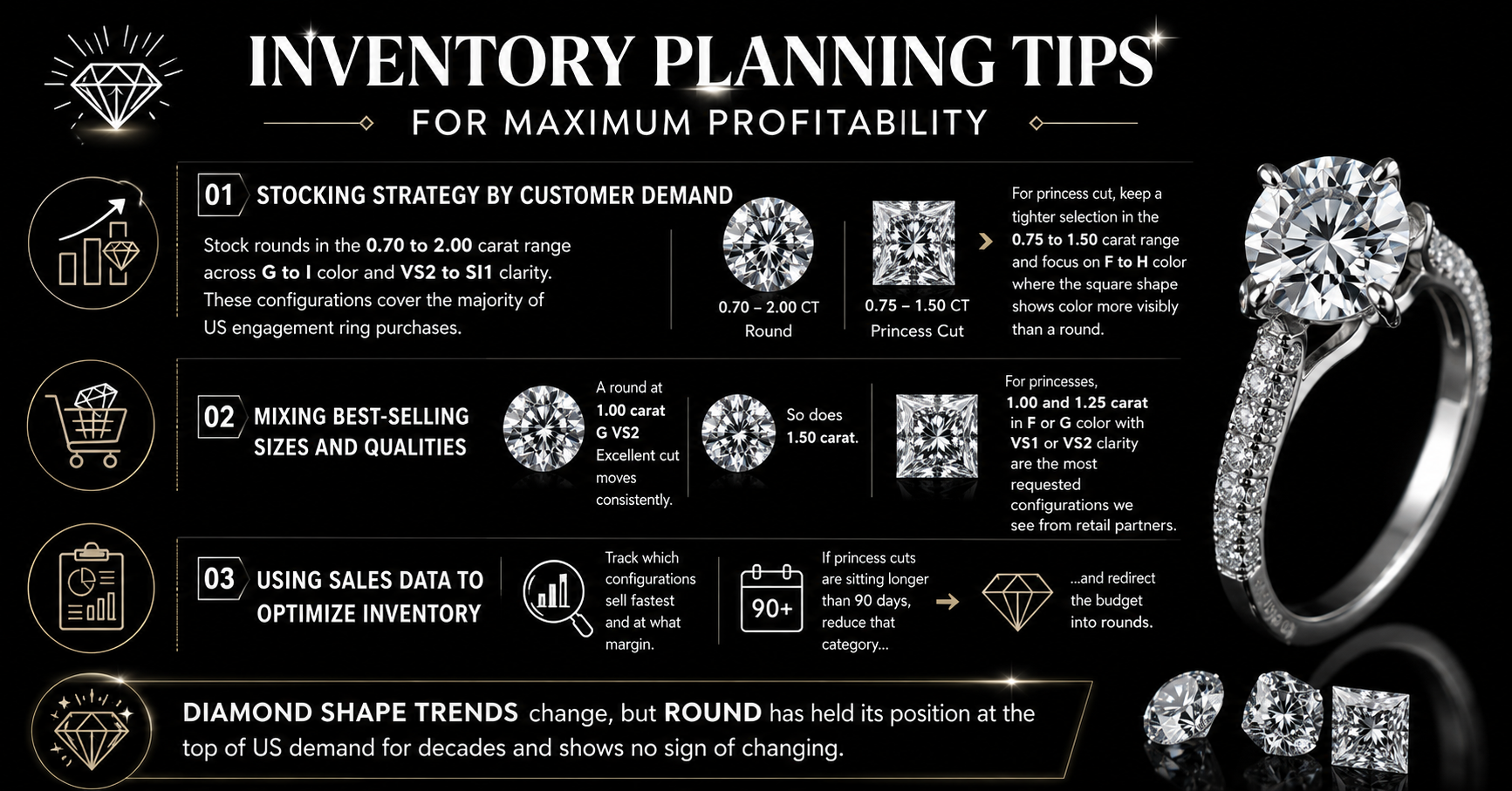
Stocking Strategy by Customer Demand
Stock rounds in the 0.70 to 2.00 carat range across G to I color and VS2 to SI1 clarity. These configurations cover the majority of US engagement ring purchases. For princess cut, keep a tighter selection in the 0.75 to 1.50 carat range and focus on F to H color where the square shape shows color more visibly than a round.
Mixing Best-Selling Sizes and Qualities
A round at 1.00 carat G VS2 Excellent cut moves consistently. So does 1.50 carat. For princesses, 1.00 and 1.25 carat in F or G color with VS1 or VS2 clarity are the most requested configurations we see from retail partners.
Using Sales Data to Optimize Inventory
Track which configurations sell fastest and at what margin. If princess cuts are sitting longer than 90 days, reduce that category and redirect the budget into rounds. Diamond shape trends change, but round has held its position at the top of US demand for decades and shows no sign of changing.
Which Diamond Cut Is the Better Business Investment?
For most jewelry businesses serving the US market, round is the anchor cut. It has the highest demand, the strongest resale liquidity, and the most consistent buyer profile. Princess cut is a profitable addition, not a replacement. Stocking both gives you coverage across the two most recognizable square and round shapes in the market without overcommitting to a category with smaller total demand.
If your business is in its early stage and inventory budget is limited, start with rounds. Add princess cuts when you have data showing demand from your specific customer base.